+91 9898181101
 +1 (647) 971-4687

User-Friendly Ecommerce Website Development: Step-by-Step Guide
Latest Ecommerce Market Statistics – Key Facts and Figures
E-commerce is still expanding quickly, giving companies a ton of chances to grow their clientele. The following recent data and statistics illustrate the present status of the global e-commerce market:
- In 2025, the eCommerce market is expected to generate US$4,324.00 billion in revenue.
- By 2029, revenue is anticipated to expand at a compound annual growth rate (CAGR) of 8.02%, reaching a predicted market volume of US$5,887.00 billion.
- The majority of income is produced in China, where the market is expected to reach a value of US$1,383.00 billion by 2025.
- By 2029, there are projected to be 3.6 billion users in the eCommerce market.
- By 2029, user penetration is predicted to reach 49.1%, up from 42.4% in 2025.
- It is anticipated that the average revenue per user (ARPU) will reach US$1,559.00.
Need of an Ecommerce Website Development
It is evident from the aforementioned data that businesses may gain a great deal from the growing e-commerce market. Let’s now explore the main benefits of e-commerce websites, which offer companies a wide range of chances to connect with their target market.
- Increasing Your Global Presence: Your company can reach a global audience by developing an e-commerce website. By eliminating geographic restrictions, you can reach clients worldwide with your goods and services.
- Operating around-the-clock: Your e-commerce store is always open to clients, enabling them to shop whenever they choose, which boosts your potential sales.
- Developing Your Brand Identity: By increasing your company’s online visibility, an e-commerce website draws in new clients and improves brand awareness among online buyers.
- Enhancing Customer Convenience: Customers can shop online with the convenience they want. From the comfort of their homes, they may browse products, read reviews, evaluate costs, and make purchases.
- Increasing Marketing Opportunities: Without having to spend a lot of money on traditional advertising, retailers can expand their reach, improve brand visibility, draw in new clients, and increase sales thanks to e-commerce’s affordable marketing alternatives.
- Providing Tailored Shopping Experiences: Companies can provide customized shopping experiences that make clients feel appreciated and promote repeat business by utilizing customer data from e-commerce platforms.
- Secure Transactions: Despite the hazards associated with online transactions, such as fraud and cyberattacks, e-commerce websites may guarantee security by implementing data protections, encryption, fraud prevention, and secure payment gateways.
6 Crucial Steps for Successful Ecommerce Website Development
The next section lists six crucial stages for developing an e-commerce website, regardless of whether you want to start a clothes line or create a booking website for your service-based company.
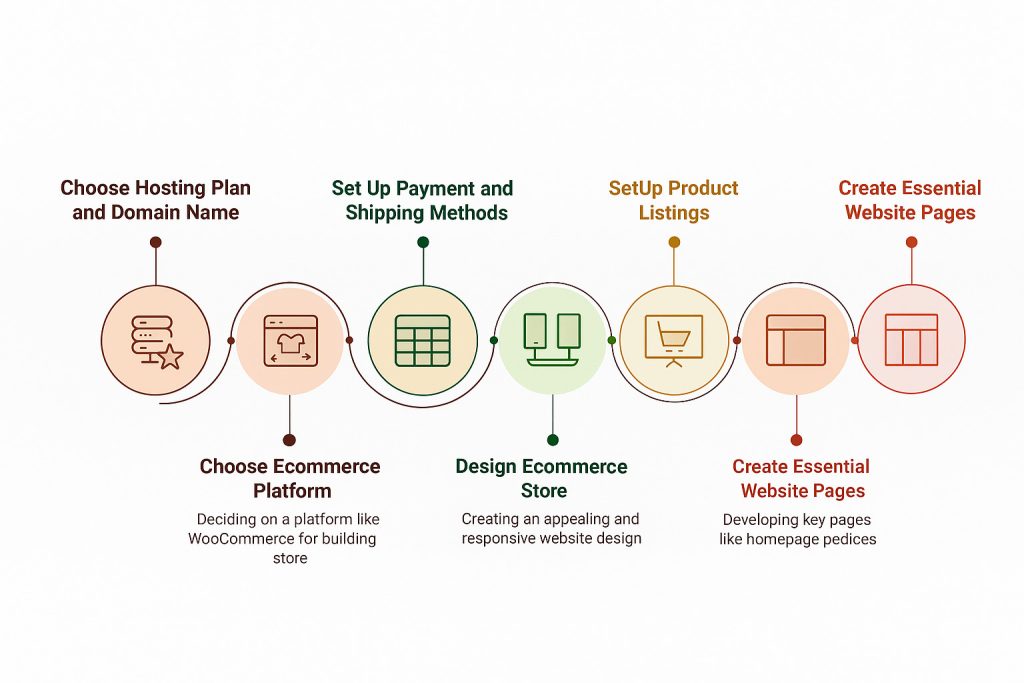
1. Choose a Hosting Plan and Domain Name
Making your company available online requires web hosting. It keeps your e-commerce store’s files safe and makes sure customers can access them.
Finding a reliable hosting company can be challenging, though, given the abundance of options available. Budget-friendly solutions may appear alluring, but keep in mind that they could limit the features of your e-commerce website.
When selecting a web hosting company, keep the following important criteria in mind:
- Uptime Guarantee: To prevent downtime, which can affect SEO and sales, pick a supplier with at least 99.9% uptime.
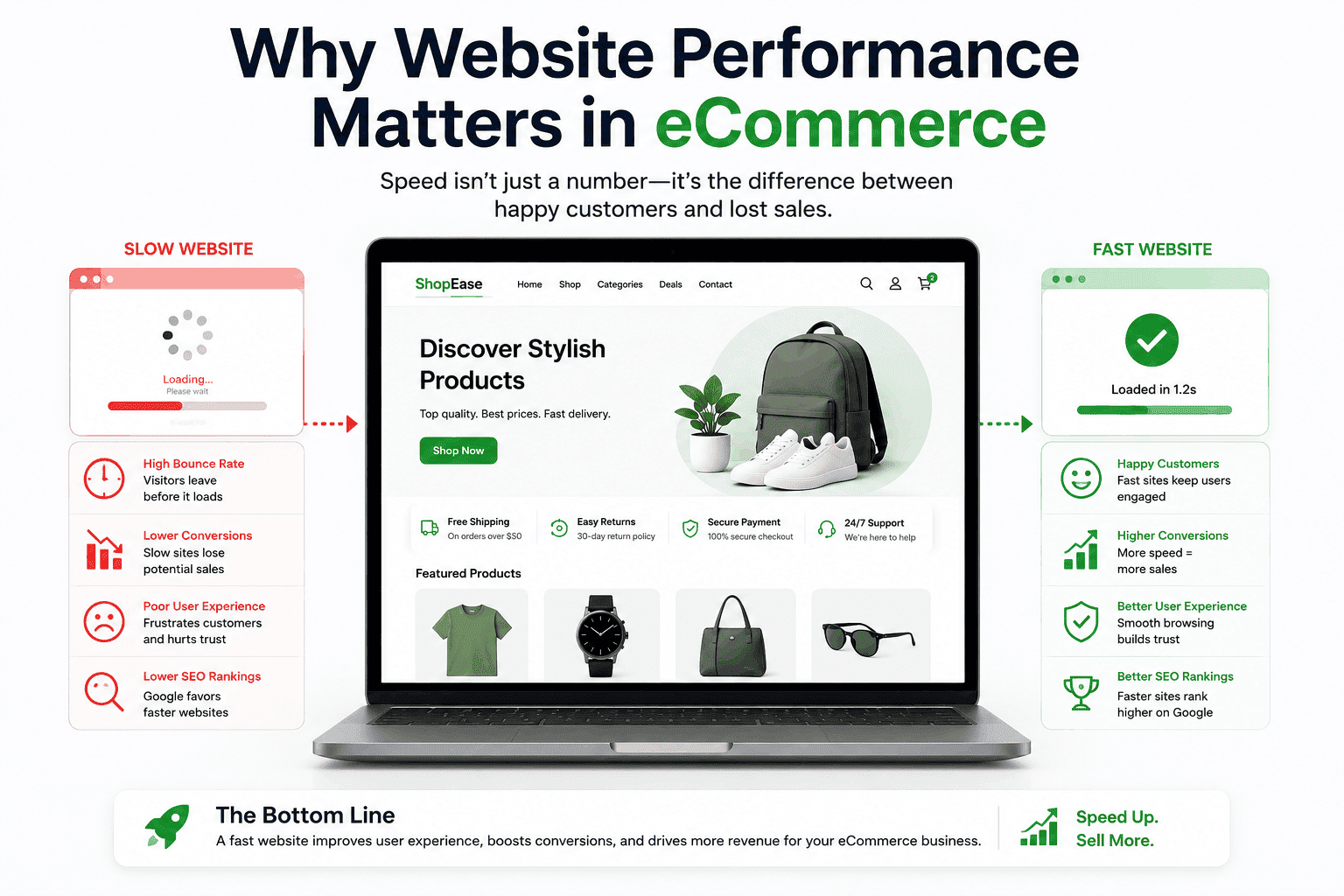
- Speed and Optimization: User experience and SEO are enhanced by quick load times. Seek for servers with robust CDN support and server response times under 200 MS.
- Bandwidth: More traffic is possible with a larger bandwidth. For best results, choose hosts with unrestricted bandwidth.
- Storage: To prevent running out of room, make sure that material like photos and movies has enough storage.
- Security: Seek out suppliers with robust security features, such as firewalls, SSL certificates, and automatic backups.
- Ease of Use: Managing accounts may be made easier with an intuitive control panel.
- Customer service: A trustworthy supplier should give resources such as a self-help knowledge base and round-the-clock assistance.
2. Choosing a Platform for an Ecommerce Website Development
Website builders and e-commerce platforms make it simple and trouble-free to start an online business. With the help of these tools, you may improve the shopping experience, streamline daily tasks, and create your website. Think about things like price, functionality, and usability while selecting a platform. Spend some time weighing your alternatives to see which one best suits your business plan and fosters expansion.
The WooCommerce plugin is a fantastic option whether you currently use WordPress or want to do so. Once activated, this open-source, free plugin turns your website into a fully working online store. Numerous e-commerce services are offered by WooCommerce, including shipping carrier choices, integrated SEO tools, payment gateway connectors, and customisable shop templates. After installing the plugin, you can follow a simple setup process to have your online store up and operating on this user-friendly platform.
3. Set Up Payment and Shipping Methods
To handle transactions properly, it is essential to set up a secure payment gateway, whether it be online or offline. Payment connections, like WooCommerce Payments for WooCommerce, are integrated into the majority of e-commerce systems. They also frequently accept a number of third-party payment processors, including PayPal and WooCommerce Stripe.
By setting up the tax zones and unit tax rates, be sure to remember to collect sales tax. After that, you may use sales tax software like Quaderno or Avalara to automate tax computations for your transactions.
Additionally, your e-commerce store’s fulfillment and shipping alternatives will be of interest to your potential consumers. Business owners should investigate options like curbside pickups in addition to including shipping services.
4. Design of Your Ecommerce Store
Your brand message is mostly communicated through the design of your e-commerce website. In order to appeal to your target audience, carefully consider how you employ layouts, colors, and fonts. Business entrepreneurs no longer have to start from scratch thanks to pre-made WordPress themes and website builder templates.
With the help of these themes and templates, creating eCommerce websites is made easier since you can change any component without knowing how to code. By the end of 2025, it is anticipated that 43.4% of e-commerce transactions will take place on mobile devices. To guarantee that your online shop functions well on all platforms, we advise choosing a responsive e-commerce design.
5. Set Up Product Listings
Customers can find information about the goods or services that are for sale on the product listing page. Product lists often include:
- Product names and costs
- Videos or pictures of the product
- Product descriptions
- Reviews from customers
- Options for shopping carts
- A section dedicated to frequently asked questions
Make sure that your listings have high-quality product photographs since media assets attract users’ attention. Hiring experts isn’t always necessary for product photography. Here are some pointers for creating visually attractive product images:
- Make your idea clear: Presenting things in a lifestyle context is a fantastic strategy. Take pictures of your goods in its natural environment, for example, if you offer outdoor gear. This strategy highlights the product’s benefits and qualities.
- Get your equipment ready: It’s worthwhile to spend money on a decent camera and a sturdy tripod in order to take excellent product photos. Make sure you have the best lighting possible if you’re filming indoors.
- Prepare the scene: To make sure the photo session goes well, set up the space, take practice images, and practice the procedure.
- Take pictures of the products: Take pictures from multiple viewpoints so that prospective buyers may see the goods from a variety of angles.
- Enhance the photos: In this last phase, entrepreneurs can make changes to raise the caliber of the photos.
6. Essential Ecommerce Website Pages
The main pages of your website should be easily navigable and attractive in order to draw in and convert visitors. The following pages should be your main focus:
- site: Since it serves as the majority of visitors’ initial impression, your site should be easy to navigate, interesting, and fast to load. Include a search bar and product categories for simple navigation, and use compressed material to speed up loading.
- About Us: By sharing your brand’s vision and narrative, this site helps you recruit partners and gain the confidence of your customers. To make your brand more relatable, highlight the history and core principles of your business and introduce your staff.
- Reach Out to Us: To foster trust, make your contact information readily available. Add your address, phone number, and email address. You could also want to use a contact form to generate leads.
- FAQ: Provide answers to frequently asked consumer queries, such as order tracking or delivery, and make use of a search bar to assist users in finding information fast.
- Privacy Policy: To guarantee adherence and openness, prominently disclose your privacy policy. Put it in places where people will see it, such checkout pages.
- Return and Refund Policy: Clearly state what may and cannot be returned, as well as how to make a return or exchange request.
- Organize shopping carts with product descriptions and clear pricing breakdowns before checking out. For more seamless transactions, make sure the form is simple to fill out and provide guest checkout.
Ecommerce Website Development Cost
Let’s separate the whole cost of developing an e-commerce website into two groups:
- Fixed costs are recurring expenditures such web hosting, domain registration, developer pay, and engineering staff compensation.
- Variable Costs: You may choose the website’s features, performance, design, and capacity based on your financial constraints. Spending little will help you reduce variable expenditures.
| Website Size | Estimated Price Range |
|---|---|
| Small (Up to 100 products) | $1000 to $10000 |
| Medium (100 to 500 products) | $10000 to $50000 |
| Large (500+ Products) | $50000 to $200000 |
Conclusion
Numerous benefits come with developing an e-commerce website, which benefits both customers and businesses. Building an e-commerce website for your company expedites the purchasing process, makes it easier to create product listings, promotes client confidence, guarantees round-the-clock availability, and boosts sales.
You may also choose to utilize pre-made themes for your website or have a bespoke e-commerce website developed. For more advice, think about getting in touch with an e-commerce web development business that can offer knowledgeable assistance all along the way.