+91 9898181101
 +1 (647) 971-4687
Which is better for your company, Shopify or Magento?
So, which e-commerce platform will you pick to be your success partner in this fantastically competitive field that helps small and medium-sized businesses and helps giant corporations advance their brands?
Magento and Shopify are two major competitors in this market. Each of them provides a variety of features and advantages that are customized to meet the demands of various businesses. It can be difficult to decide between two of the biggest names in e-commerce, which is why we have created this comparison guide.
To assist you in selecting the ideal platform for your company, we will examine the main distinctions between Shopify and Magento in this post.
Recognizing Your Company’s Needs
Although maximizing profits and cutting expenses are the main objectives of any business, these are not the only motivations for entrepreneurs to launch their ventures or even decide to build their brands.
Because it enables them to participate in the thriving online marketplace without having to pay for a physical storefront, eCommerce is a popular choice for new business owners. Others, on the other hand, use e-commerce to expand their brand’s reach beyond geographic borders and attract new clients.
Similar to this, different companies may have different objectives when they work with e-commerce development firms to help them design the ideal e-commerce website. Your selection of the ideal e-commerce development platform may vary depending on your company’s size, industry, financial constraints, and future growth or expansion goals. Therefore, before selecting an e-commerce development platform such as Magento or Shopify, it is crucial to comprehend the needs and requirements of your company.
That seems like a lot of work, doesn’t it? We are here to make this process easier for you, so don’t worry. Let’s first examine the precise meanings of these two e-commerce platforms.
Overview of Magento and Its Main Features
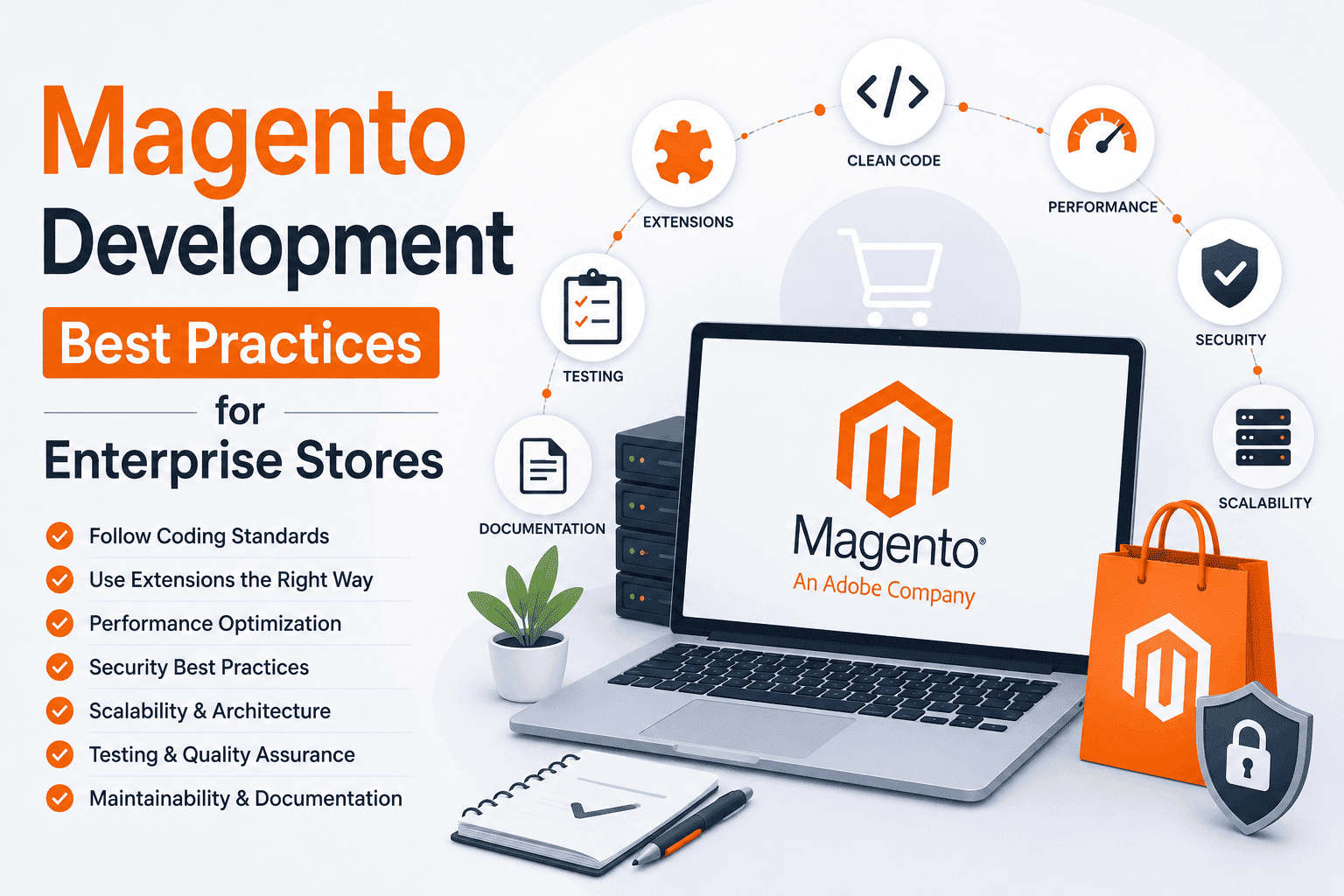
Similar to WordPress, Magento is an open-source e-commerce development platform that is written in PHP and assists programmers in creating e-commerce websites for businesses. Installing it is free, but you will need to pay for security, apps, extensions, and web hosting.
Founded by Roy Rubin and Yoav Kutner in 2008, Magento was purchased by Adobe in 2018 for an astounding $1.68 billion. These days, it’s called e-commerce. Because it requires coding, it is well-known for being a strong e-commerce platform that is primarily utilized by large corporations that employ Magento developers or have internal web development teams.
Key attributes:
- Customization: Magento provides a wide range of customization options that let you precisely customize your online store and its contents to meet your needs.
- Scalability: Companies of all sizes can easily use it. Despite being primarily preferred by large corporations, it can easily accommodate startups and small and medium-sized businesses.
- Built for SEO: To improve your e-commerce website’s position in search engine results, Magento offers a wealth of integrated SEO tools.
- Huge Community: Magento boasts a sizable and active developer and user community that provides information and support for all extensions and plugins.
Overview and Essential Features of Shopify
Easily one of the largest e-commerce platforms in the world, Shopify is a user-friendly solution designed specifically for creating e-commerce websites, or online stores. Shopify can easily accommodate businesses of all sizes and types, from independent boutiques to some of the biggest brands in the world.
Tobias Lütke, Daniel Weinand, and Scott Lake founded Shopify in 2006. A little-known fact is that Shopify was an online store selling snowboards before it evolved into a platform for creating online stores.
Unlike Magento, Shopify is a paid platform and is widely recognized as the preferred choice for young and aspiring business owners. In exchange for offering users a large selection of themes, apps, and round-the-clock support, it charges a monthly fee.
Important features:
- Simple to Use: From the start, setting up and running your store is a breeze thanks to Shopify’s incredibly intuitive interface.
- Hosting Included: Users don’t have to worry about server management because Shopify takes care of website hosting.
- App Ecosystem: A range of apps and plugins are available in the Shopify app store to help users enhance the features and functionality of their e-commerce store.
- Scalability: Shopify Plus is best suited for small to medium-sized businesses, but it can meet enterprise-level needs as well.
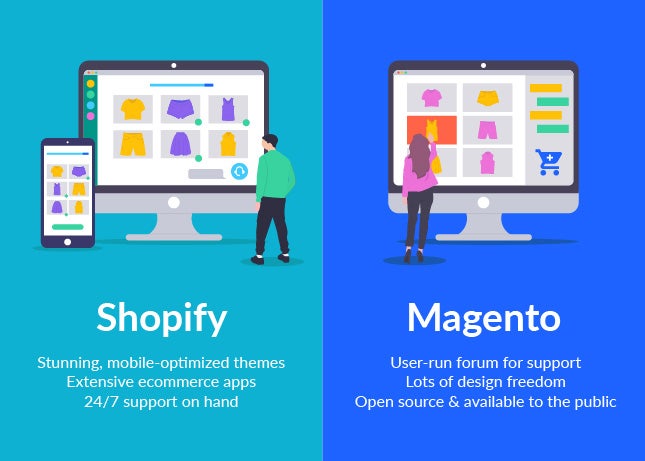
It is clear from the above comparison of the two e-commerce platforms—Magento and Shopify—that Shopify is best suited for startups seeking a hassle-free experience, while Magento is best suited for companies with access to knowledgeable resources (ecommerce developers).
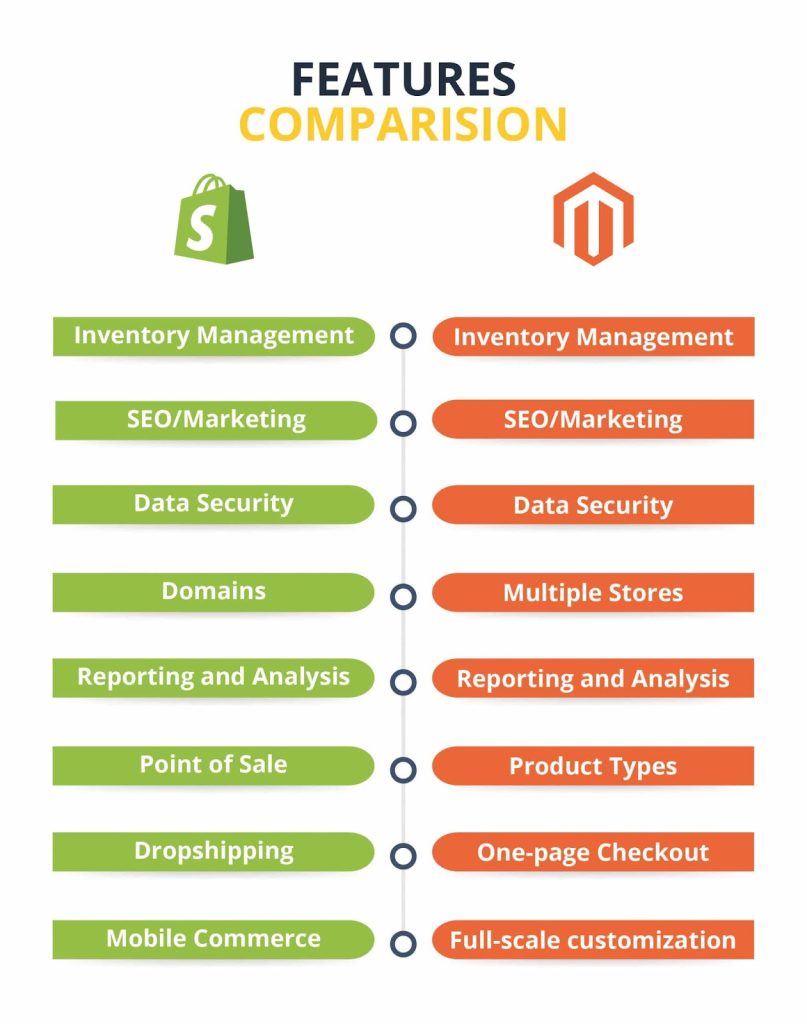
Weighing the advantages and disadvantages of the two e-commerce platforms to determine which best suits your company’s needs is the next step.
The Pros and Cons: Magento vs. Shopify
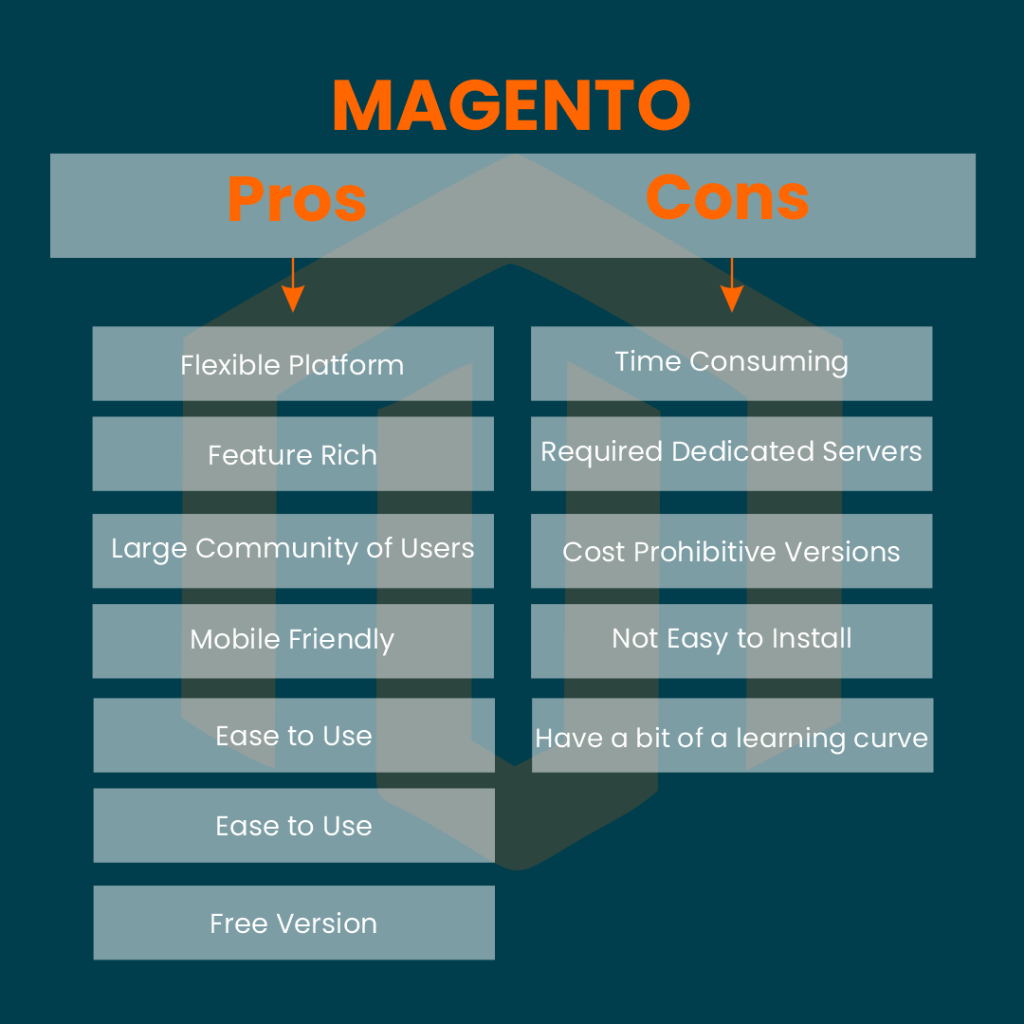
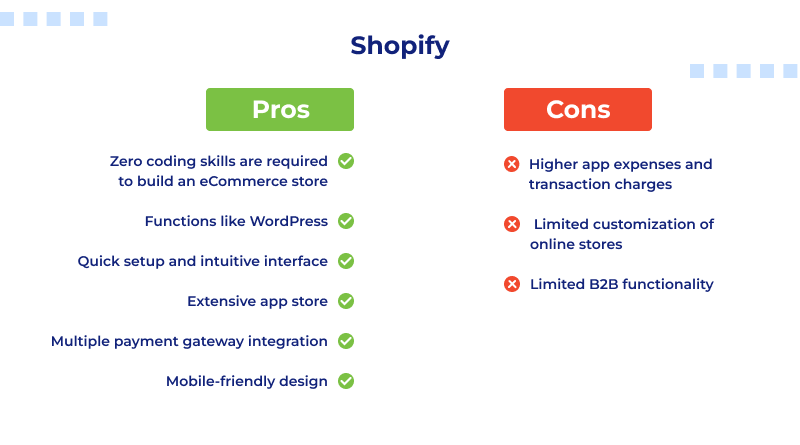
These are a few significant advantages and disadvantages of these two platforms that will undoubtedly influence your choice to host your website on one of the others, even though they are not all of them.
Comparing the Costs of Shopify and Magento
After reading the benefits and drawbacks of both Magento and Shopify, it’s time to proceed to the most crucial aspect of the comparison: the price comparison.
As previously stated, Shopify is a paid platform, which may lead you to believe that it is more costly than Magento. However, let’s put that aside for the time being. The catch is that Magento requires an external provider, like SiteGround, to run, which can cost anywhere from $10 to $30 per month, even though it is open-source and free to install.
In addition, the following is a basic breakdown of Shopify and Magento’s prices:
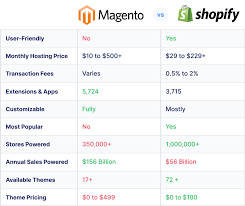
Additionally, Shopify provides Shopify Lite, another reasonably priced option for small businesses, and Shopify Plus, which is targeted at large corporations. While Magento requires payment for domain registration, security, and web hosting, Shopify is a hosted platform, so you don’t have to worry about these extra expenses.
This is why you should never judge a book by its cover. Although Magento’s free installation might appear to be a more affordable option than Shopify’s monthly subscription fee, we can see the platform’s hidden costs here, including the price of hiring Magento developers.
Comparing Magento and Shopify in terms of usability and ease of use
The main user of the e-commerce platform is you, the business owner. You are only inviting more problems down the road if you choose a platform that is too hard to even set up.
Selecting a platform that is easy to customize is essential; otherwise, you won’t be able to realize your store’s vision, disappointing customers and harming the reputation of your brand.
Shopify is undoubtedly more user-friendly than Magento. Without the need for complicated coding, you can alter the storepage features as you like using Shopify’s drag-and-drop website builder. Therefore, it is easy to conclude that Shopify is user-friendly even for non-technical people, while Magento is only suitable for web developers.
Topics: Shopify versus Magento
The theme and design of your website are the first things a user or customer notices when they visit it, and if they don’t think it’s appropriate, it’s one of the main reasons they leave it quickly.
Having said that, online shoppers place a great deal of importance on first impressions, so you should carefully consider your theme and site template. Shopify provides its users with 64 premium themes that range in price from $140-$180 and 10 free themes. The fact that all of its themes are responsive to mobile devices is another crucial consideration. This is a groundbreaking story that you should consider, especially since more and more customers are shopping on smartphones.


Additionally, Magento provides users with ready-made themes, which typically cost $100. However, because the platform is well-known for its highly customizable themes, those can cost anywhere between $600 and $25,000.
Comparing Magento and Shopify’s Marketing Features and Sales Tools
With the aid of efficient marketing tools, expanding your business is simple and straightforward. Who doesn’t like that, after all? Shopify also gives you the best marketing features and sales tools to help you close the deal.
In addition to providing you with multi-channel sales on Facebook, Instagram, Amazon, and other platforms, Shopify has partnerships with courier service providers like USPS, DHL, UPS, and others to save you the headache of finding your own courier service.
Don’t worry, though; Magento offers extensions that enable you to use multi-channel selling and create your own personalized checkout, so it doesn’t fall behind Shopify in this area.
Shopify comes with all of these features, but Magento requires the installation of complex extensions to provide the same functionality.
SEO: Shopify vs. Magento
When discussing online business, search engine optimization, or SEO, cannot be disregarded. Because it directly translates to gaining more clients and revenue, SEO is crucial to increasing search engine traffic to your website.
In this regard, Magento is superior to Shopify. Shopify relies on its apps for SEO, whereas Magento is excellent at it thanks to its numerous prompts and guides. In Magento you can edit the Alt tags for your images and also change the URL of your website through its built in features which ultimately helps your website rank higher on SERPs.
Installing additional apps is necessary when using Shopify to improve the SEO of your website.
Features of Payment and Security: Magento vs. Shopify
Payment processors play a significant part in all online transactions. Fortunately, both platforms are highly secure and adept at facilitating a seamless transaction between your store and the payment processors.
Users benefit greatly from Shopify’s in-house payment processor, Shopify Payments, which charges no transaction costs (apart from the credit card processing fee). If you want to use a payment gateway rather than Shopify Payments, there is a payment processing cost. More than 100 payment channels are supported, including the most widely used ones like Apple Pay, Amazon Pay, Paypal, and others.
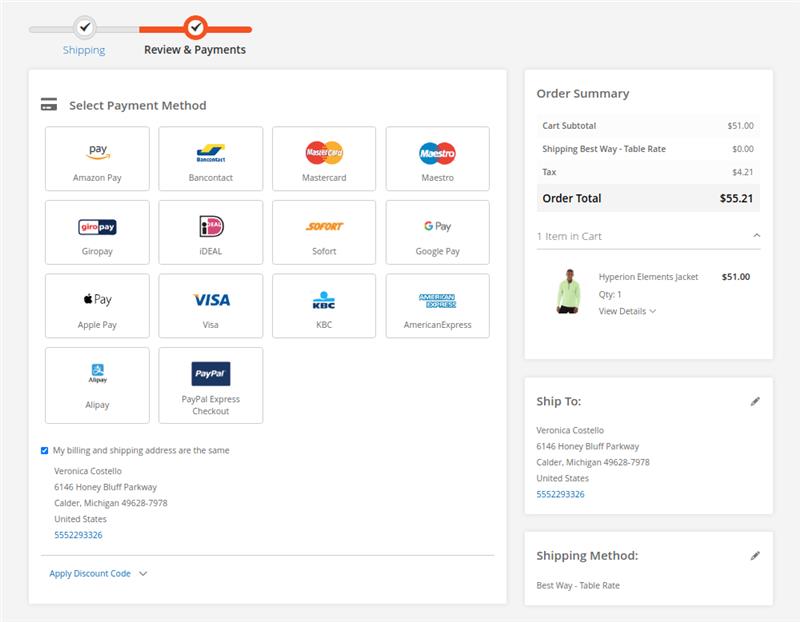
More than 150 payment gateways are supported by Magento, however most of them are geared at big business transactions like WorldPay. It does, however, enable you to use your Magento-based inventory for direct sales on Amazon.
Support and Community: Shopify vs. Magento
It will malfunction occasionally, just like any other piece of technology. The winner in this case is the one where you can easily get support and assistance to resolve the problem and get back on your feet so you can resume operating your business.
Fortunately, the help and support sections of both of our systems are comprehensive. Because of Shopify’s diverse and sizable user base, users can easily ask for assistance and information when they need it. Additionally, it has following characteristics for support:
- round-the-clock phone assistance
- Social media assistance
- Forum for the community
- Email assistance
- Assistance center
- Tutorial videos
- Advanced assistance from specialists
However, because Magento is a more complicated platform to use, it has its own user manuals and more detailed instructions to assist you create your online store because it is a user-community based platform. Users will also have access to SiteGround’s assistance and support staff for any problems they may be having.
As this comparative guide draws to a close, I hope you now have a firm grasp on which platform best fits your company’s size, scope, sector, and financial constraints. If not, let’s review the brief synopsis to get greater clarity.
A Comparison between Shopify vs Magento
While Shopify is preferred by over 6.9 million companies worldwide, Magento is utilized by over 700,000 shops worldwide. It is evident from this straightforward data that Shopify is the most user-friendly of the two platforms. However, being easy to use does not always mean that it is the best option for your company.
Choose Shopify if:
As a novice entrepreneur, you possess minimal technical expertise and experience.
You must launch your web business more quickly and first target a small audience.
Your company has a smaller budget.
Choose Magento if:
You might have an internal development team or hire Magento developers.
Because customizing projects requires more time, have the time and resources to maintain a long-term development project.
Possess a solid clientele and adequate financial resources.
About the author: admin