+91 9898181101
 +1 (647) 971-4687
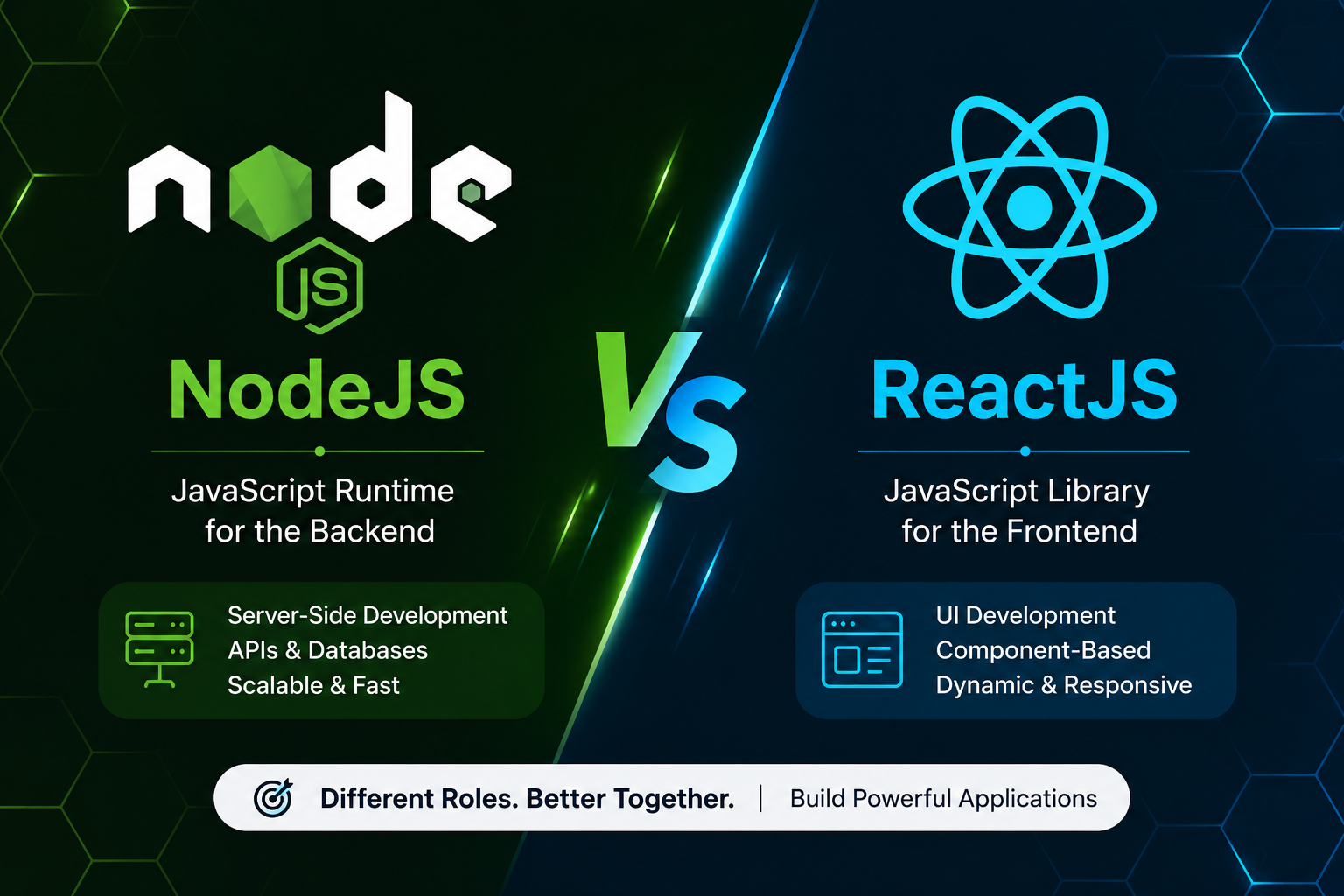
NodeJS vs ReactJS – Full Comparison of Performance, Scalability, and Use Cases
Choosing between ReactJS and NodeJS for your development project is a common question. The answer is that it relies entirely on the needs of your project.
First of all, while being open-source JavaScript technology, they are completely different.
To help you make a decision, let’s examine both technologies in detail.
What is NodeJS?
It is a cross-platform runtime environment that allows JavaScript code to be run outside of a browser. JavaScript scripts run on the client’s browser and make web pages interactive, even though they were primarily employed for client-side scripting.

JavaScript is used by NodeJS developers for server-side programming, however.
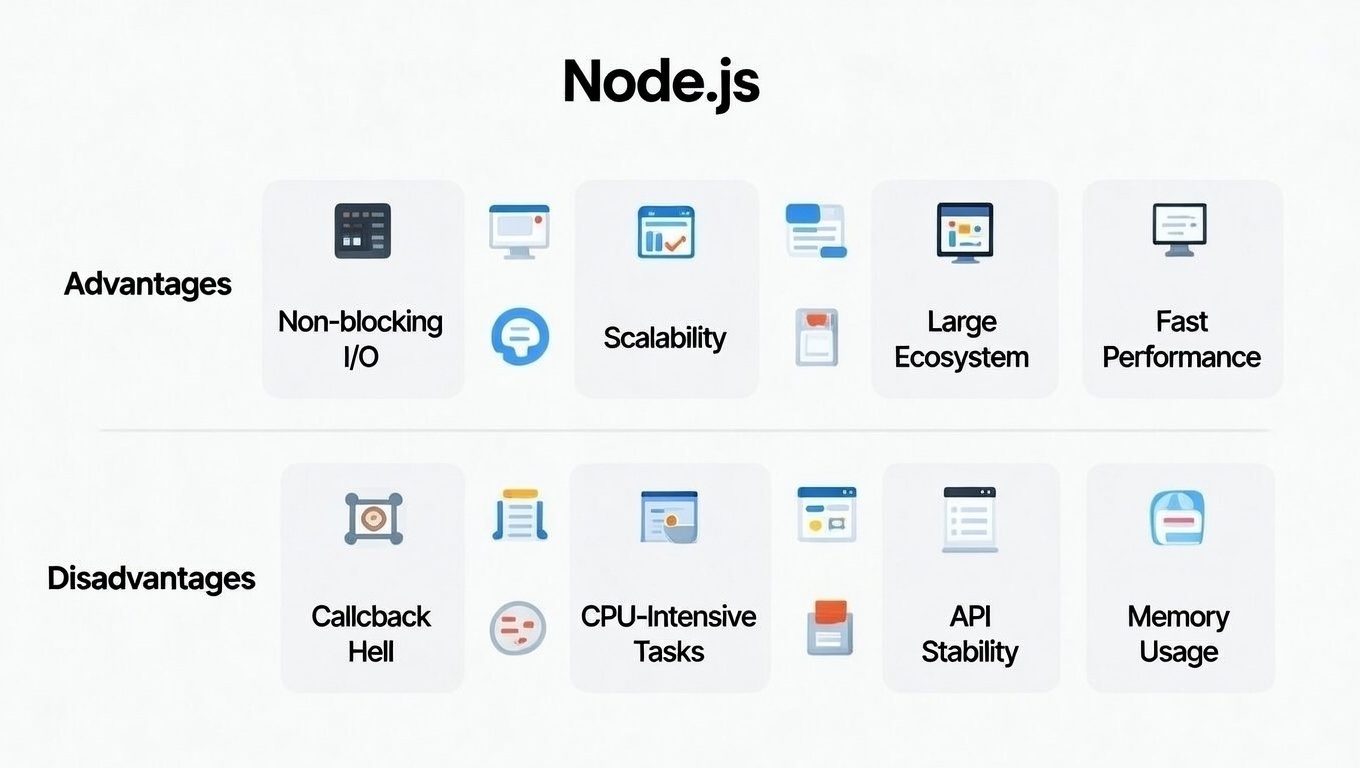
Advantages of NodeJS
You now understand NodeJS and its applications. Let’s examine its benefits so you can decide.
1. Speed & Efficiency
JavaScript is directly compiled into native machine code by NodeJS using Google’s V8 JavaScript Engine. Applications can run more quickly as a result. Its non-blocking I/O operations and event-driven architecture increase its speed and effectiveness.
As a result, it can manage real-time applications that require a lot of data.
2. Unified Programming Language
NodeJavaScript, a client-side programming language used by JS, enables programmers to write client-side and server-side scripts in the same language. Because of this benefit, the development process is streamlined and the complete code base may be managed by the same team.
3. Robust Community Assistance
Numerous modules and tools are accessible through Node Package Manager because to its large and vibrant community. Developers may discover tools and libraries for almost any functionality they wish to design thanks to this ecosystem.
4. Perfect for Microservices Design
Because NodeJS is lightweight and modular, it is appropriate for a microservices design. It is perfect for businesses who wish to divide their apps into smaller yet linked services.
This is because of its efficiency with input and output operations and its capacity to manage asynchronous calls.
5. Business Assistance
Additionally, this technology has a lot of corporate support, and industry titans like Google, Microsoft, and IBM guarantee its ongoing advancement. Because of this, other companies can be confident in NodeJS’s long-term viability.
6. Sturdy Technology Stack
Many stacks, such as the MEAN stack (MongoDB, ExpressJS, AngularJS, and NodeJS), depend heavily on NodeJS. This enables programmers to create robust and dynamic web applications.
This expedites the distribution of applications and streamlines the development process.
7. Expandability
NodeJS’s scalability is one of its main advantages. The event loop enables NodeJS to carry out non-blocking input/output activities in contrast to conventional threading.
Because NodeJS can manage multiple connections at once, it is a popular option for online games, instruments for collaboration, and live chat applications.
NodeJS’s drawbacks
Although there are benefits to utilizing NodeJS, there are also some drawbacks. Let’s examine the same.
1. Using Relational Databases
In contrast to non-relational databases, which do not have any relationships between tables, relational databases store data in tables that are related to one another.
A JavaScript runtime that works well with relational databases is called NodeJS. Additionally, it features a MySQL module that facilitates database operations and connects to a MySQL database.
But as certain libraries are harder to use than others, this can also be a drawback.
2. Unreliable API
For developers that need the API to be consistent in order to maintain their own applications, an unstable API can be a pain in the ass.
Software that is hard to update and maintain can result from an unreliable API.
Note that the API is unstable if you are using NodeJS. This implies that your code may be broken and that it may change at any time. Thus, be informed about the most recent modifications.
3. Model of Asynchronous Programming
Program execution in this programming model doesn’t wait for all program pieces to be processed.
Program components that can function independently of one another are handled in parallel in asynchronous programming. Sequential processing is used for program pieces that can function independently.
4. Unsuitable for Tasks Requiring a lot of CPU Power
Because NodeJS apps are single-threaded, they can only utilize one CPU core at a time. For CPU-intensive applications, this could be a disadvantage.
JavaScript is run on the server side by NodeJS, a runtime environment. JavaScript is a front-end programming language that completes work quickly by using a single thread. Because these jobs are lightweight, threading is not necessary for them to function.
5. Does Not Have a Robust Library Support System
Compared to other programming languages, NodeJS is very new and has fewer high-quality libraries available. Finding the appropriate library for a task can be challenging as a consequence.
Additionally, NodeJS libraries are less feature-rich than libraries for other languages. This complicates software development and may result in additional coding errors.
6. Leaks in Memory
Memory leaks can occur in a poorly coded web application. When a piece of code allocates memory but does not release it, this is known as a memory leak. The NodeJS process may consequently run out of memory and crash.
Although memory leaks can be avoided, doing so in a complicated program is challenging.
7. Security Issues
The dependence on third-party programs raises the possibility of security flaws. In order to lower risks, developers must do security audits and update dependencies on a regular basis.
What is ReactJS?
Facebook created the open source JavaScript package React, often known as ReactJS, to let developers create user interfaces or UI elements.
It emphasizes performance and maintainability while making the development of single-page apps easier. Instead of working directly with the browser’s DOM, it creates an in-memory virtual DOM.

Before making changes to the actual browser DOM, ReactJS executes the necessary operations on these virtual representations.
Benefits of ReactJS
For contemporary web development, ReactJS developers provide numerous benefits. Let’s examine some of the main benefits of utilizing ReactJS.
1. Optimized for search engines
ReactJS uses technologies like Server Side Rendering (SSR) and Static Site Generation (SSG) to construct SEO-friendly applications. Search engines can easily crawl and index the content produced by React.
As a result, you increase user experience, SEO, and search rankings by speeding up load times.
2. Reusable Parts
With React’s component-based architecture, developers can divide the user interface into more manageable parts. Because these self-contained code segments are reusable, the development process is simple and effective.
It is significantly simpler to update or correct bugs when components are segregated. Because ReactJS saves time on repetitive elements, this enables speedier development.
3. Development of Cross-Platform Mobile Apps
With a single code base, React Native enables the creation of native mobile apps for both iOS and Android. Faster development and the possibility of cross-platform code reuse are the outcomes.
Near native app performance is provided by ReactJS.
4. Quick Rendering
React uses the Reconciliation Algorithm and the Virtual DOM to render content quickly. This reduces pointless re-renders and enhances the application’s responsiveness.
To determine what changed, a reconciliation algorithm is required to compare the old and new virtual DOMs. To reduce the amount of modifications required to apply real DOM, React uses an efficient diffing approach.
5. Robust Community Assistance
There is a sizable, vibrant ReactJS community that is supported by Meta. For developers, it offers a vast ecosystem of tools, resources, and libraries.
There is a ton of third-party libraries, tutorials, and documentation available for React. Solutions and help are easily accessible through forums and GitHub.
6. Flexibility and Performance Optimization
Because of its component-based architecture, ReactJS is renowned for providing flexibility. It is optimized for efficiency with features like code-splitting, lazy loading, React memo, and support for various rendering techniques.
7. State Management with Redux
Managing application state is complicated for large programs. Redux maintains the whole state in one store, which aids with predictable state management.
The centralized state makes it simpler to track and manage apps. Only dispatched actions have the ability to make changes.
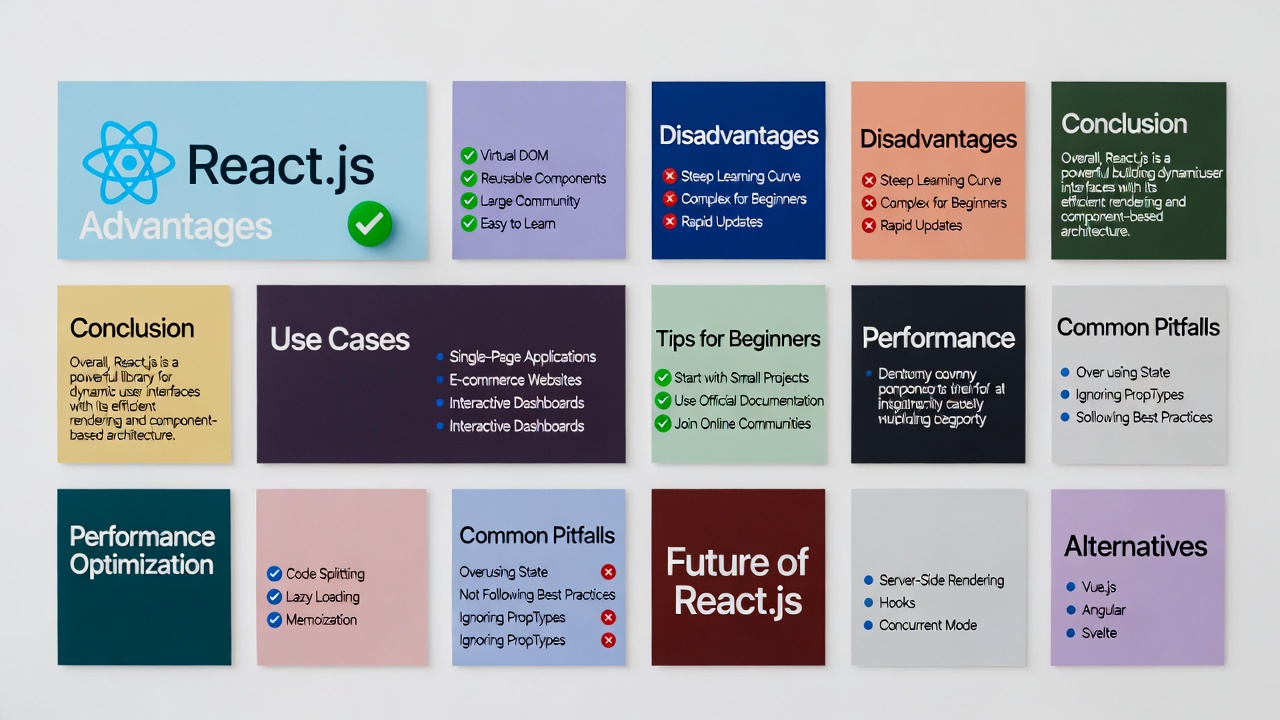
Disadvantages of ReactJS
Every technology has advantages and disadvantages, and ReactJS is no exception. Let us examine some of its drawbacks.
1. Quick Shifts
New features, modifications, and deprecated methods are being added to React. This maintains React’s efficiency and modernity, but developers must always stay up to date on the latest changes.
Long-term projects may have maintenance issues as a result. Despite React’s increasing efficiency and modernity, developers are finding it harder to keep up with the pace.
2. Overhead for Boilerplate and Configuration
There is a lot of boilerplate code and configuration to set up when you first start a React project. This is especially true when incorporating other tools and libraries.
This kind of setup takes a lot of effort and necessitates a deeper comprehension of the development environment as a whole, including bundlers.
3. No State Management Integration
React does not have built-in state management solutions for larger applications because it only concentrates on the view layer. External libraries such as Redux, Context API, or MobX are expected to be integrated by developers.
This raises the learning needs and difficulty level even further.
4. A challenging learning curve
Even though React provides many advantages, many novices find it challenging to learn. This is especially true for developers who are unfamiliar with JavaScript.
Learning ideas like component lifecycle, JSX, and state management takes time and experience. Inexperienced developers may find this difficult.
5. Restricted Opinion
ReactJS’s restricted opinionated Ness describes React’s status as a library rather than a framework.
ReactJS does not offer a particular method for managing data, handling routing, or organizing a project. Customization is made possible by this flexibility, although various development teams may use different project structures and methods as a result.
6. Inadequate Documentation
Despite having good documentation, some developers believe that React’s main website is shallow and uninformative. Additional papers are available from the React community, however they are dispersed and difficult to learn.
7. Sophisticated JavaScript
While the fundamental ideas of React are clear-cut and basic, more complex ideas necessitate knowledge of intricate JavaScript features.
These sophisticated ideas are many and present difficulties for developers who want to become experts.
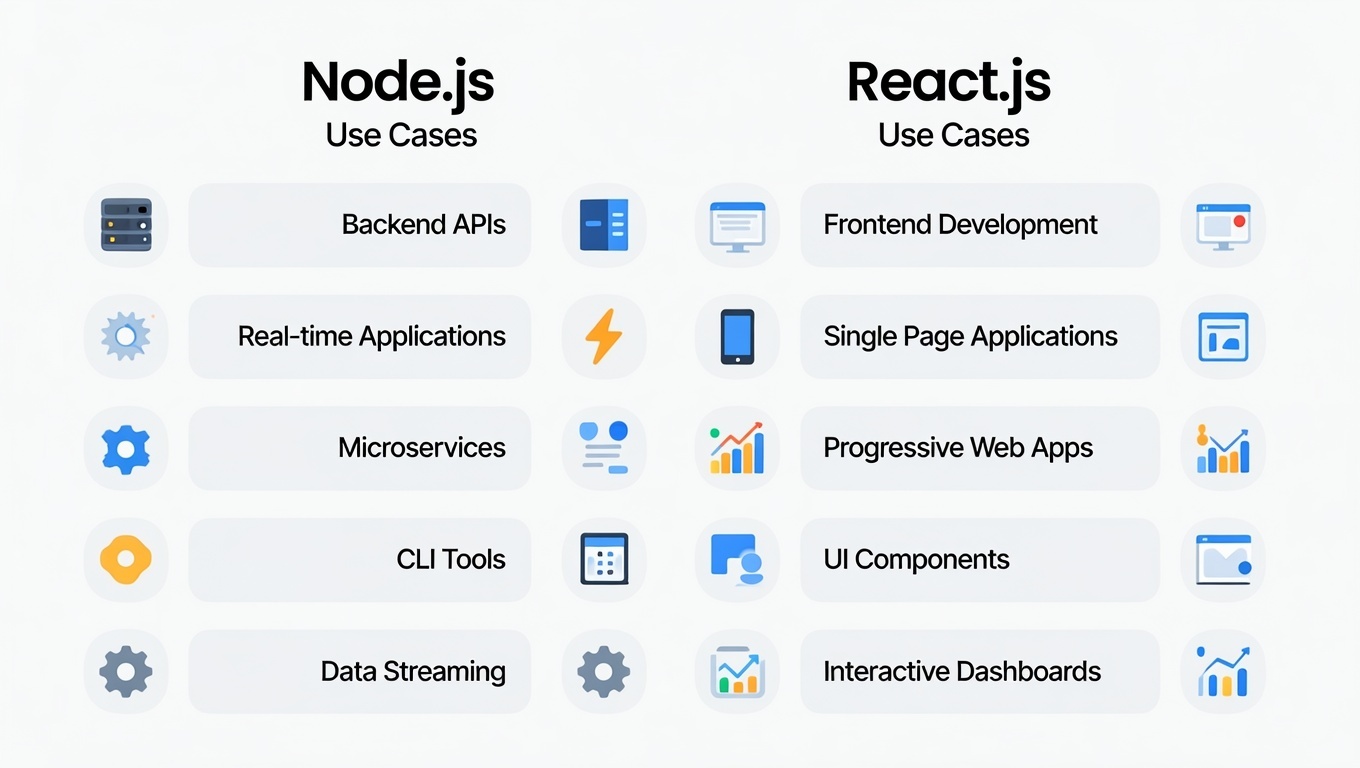
Use Cases of ReactJS & NodeJS
We have seen both ReactJS and NodeJS, as well as their advantages and disadvantages. Now, let’s have a look at the use cases of both to get a better understanding of their features.
ReactJS Use Cases
1. Netflix
ReactJS is used by Netflix to improve the performance of its online interfaces, particularly on devices with low processing power. Netflix has been able to deliver a reliable and quick user experience because of its capacity to manage intricate user interactions.
No matter the device or network conditions, Netflix can deliver a positive user experience. This benefit has been essential for preserving user interest and pleasure.
2. Airbnb
ReactJS has been used by Airbnb to modify its front-end architecture. Performance and developer productivity have increased as a result.
By using React, Airbnb has been able to achieve a modular codebase and speedier rendering times. This makes it easy for Airbnb to add new features and upgrade existing ones. Consequently, the user experience has been enhanced on both online and mobile platforms.
3. Facebook
ReactJS was developed by Facebook and is widely utilized across the organization. Facebook is able to design dynamic and responsive user interfaces because to React’s component-based architecture.
Facebook offers its large user base a smooth experience as a result. Efficient updates, maintenance, performance, and scalability are made possible by this configuration.
NodeJS Use Cases
Let’s look at the major use case of NodeJS. This will help you in making your choice.
(1) PayPal
The split codebase architecture of PayPal, an online payment platform, presented difficulties. JavaScript was utilized by PayPal for client-side scripting and Java for server-side development.
As a result, the development process became complicated and ineffective. PayPal chose NodeJS for server-side processes in order to expedite development. Because NodeJS is asynchronous, PayPal was able to process more transactions at once.
(2) Uber
Uber is a multinational travel solutions app. They needed a scalable, real-time solution to manage thousands of requests from riders and drivers at once.
Performance bottlenecks were present in their Python-built system. Because NodeJS can handle asynchronous operations and stream data in real-time, Uber decided to replace it.
Millions of queries may now be handled concurrently by Uber’s software. Both error handling and system reliability have improved.
(3) eBay
The massive e-commerce company eBay has embraced NodeJS because of its event-driven architecture and live monitoring capabilities.
A real-time monitoring system that offers immediate insights into problems and system performance was created using NodeJS. Automated maintenance scripts decreased downtime and increased system dependability.
Monitoring of growing loads was made possible by this scalable system.
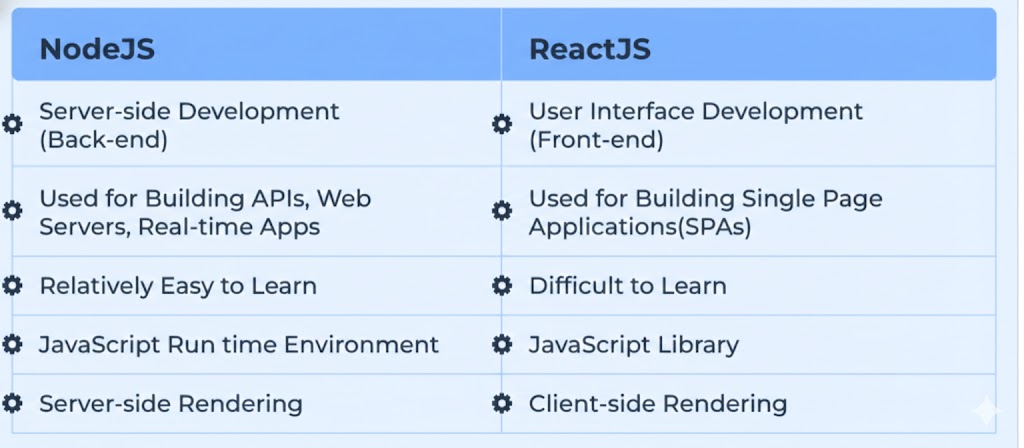
Lastly, let’s use a comparison chart to contrast Node.js and ReactJS.
Finishing Up…
You now have a solid understanding of what NodeJS and ReactJS are. You are aware of the benefits and drawbacks of each.
If you want to build real-time applications, web servers, or APIs, you should use ReactJS. On the other hand, use NodeJS when creating single-page applications (SPAs). Thus, choose based on the needs of your project.
FAQs comparing ReactJS with NodeJS
1. What are NodeJS and ReactJS?
Although both React.js and Node.js are popular JavaScript technologies in web development, their functions are different.
2. What uses do ReactJS and NodeJS have?
While NodeJS is utilized for back-end programming, ReactJS is utilized for front-end development.
3. Is it possible to use ReactJS and NodeJS in the same application?
Indeed, both frameworks may be used in tandem, and they perform well together.
4. Which databases are frequently utilized with ReactJS and NodeJS?
SQL: PostgreSQL and MySQL
NoSQL: DynamoDB, Firebase, and MongoDB
About the author: admin