+91 9898181101
 +1 (647) 971-4687
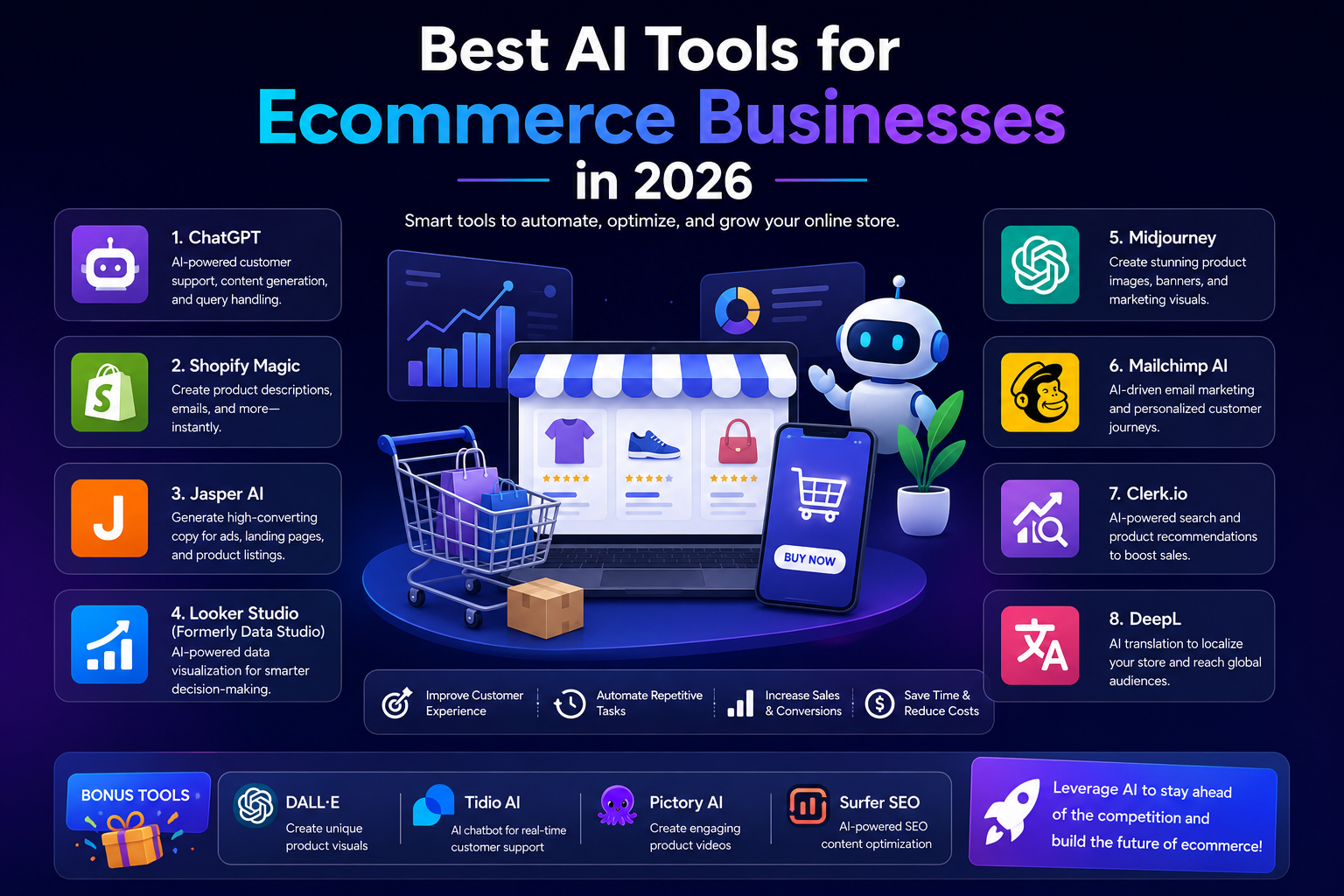
Best AI Tools for Ecommerce Businesses in 2026
Artificial Intelligence is no longer a futuristic concept for ecommerce businesses. In 2026, AI has become one of the most valuable technologies helping online retailers improve customer experiences, increase operational efficiency, boost conversions, and scale revenue faster than ever before.
Whether you’re a startup launching your first online store, a growing SME looking to automate repetitive tasks, or an enterprise pursuing digital transformation, AI tools can provide a significant competitive advantage. Modern consumers expect personalized experiences, instant support, accurate recommendations, and seamless shopping journeys. AI makes all of these possible while reducing manual workload.
According to industry reports, AI adoption in retail and ecommerce continues to accelerate, with businesses investing heavily in automation, predictive analytics, and personalized customer engagement. Companies that strategically implement AI are often seeing improvements in customer retention, operational efficiency, and overall profitability.
In this guide, we’ll explore the best AI tools for ecommerce businesses in 2026, their use cases, benefits, and how to choose the right solutions for your business goals.
Why AI Matters for Ecommerce Businesses in 2026
The ecommerce industry has become increasingly competitive. Customers have more choices than ever, making it essential for brands to deliver exceptional experiences across every touchpoint.
AI helps businesses analyze massive amounts of customer data, automate repetitive tasks, forecast demand, optimize marketing campaigns, and create highly personalized shopping experiences. Instead of relying on guesswork, ecommerce companies can make data-driven decisions in real time.
From intelligent chatbots and content generation to inventory forecasting and customer segmentation, AI is now embedded throughout the entire ecommerce ecosystem.
Key Benefits of Using AI in Ecommerce
Before exploring specific tools, it’s important to understand why businesses are rapidly adopting AI technologies.
- Personalized customer experiences that improve conversion rates.
- Automated customer support available 24/7.
- Smarter inventory forecasting and demand prediction.
- Improved marketing performance through data-driven insights.
- Operational efficiency through workflow automation.
These benefits help businesses reduce costs while improving customer satisfaction and long-term growth.
1. ChatGPT for Ecommerce Content and Customer Engagement
Best For: Content Creation, Product Descriptions, Marketing Copy
ChatGPT continues to be one of the most powerful AI tools available for ecommerce businesses in 2026. It enables teams to generate product descriptions, email campaigns, blog content, ad copy, FAQ sections, and customer communication at scale.
Instead of spending hours writing content manually, ecommerce teams can create high-quality drafts within minutes and focus on strategy, optimization, and customer engagement.
Many brands also integrate AI-powered conversational experiences into customer service workflows, helping customers receive faster answers and recommendations.
Learn more about AI advancements through OpenAI.
2. Shopify Magic and Shopify AI Suite
Best For: Shopify Store Automation
For businesses operating on Shopify, Shopify Magic has evolved into a powerful AI assistant designed specifically for ecommerce operations. It helps merchants create product descriptions, improve customer communications, automate workflows, and streamline store management.
The platform reduces administrative overhead while helping businesses maintain consistency across product catalogs and marketing campaigns.
As competition increases among online retailers, integrated AI solutions like Shopify Magic provide significant advantages without requiring complex implementation processes.
3. Klaviyo AI for Email Marketing Automation
Best For: Customer Retention and Personalized Marketing
Email marketing remains one of the highest ROI channels in ecommerce. Klaviyo’s AI-powered features help businesses create smarter segmentation strategies, personalized campaigns, predictive customer analytics, and automated engagement workflows.
Instead of sending generic messages to entire customer lists, businesses can deliver highly relevant content based on purchasing behavior, browsing history, and customer preferences.
This level of personalization often leads to higher open rates, improved conversions, and stronger customer loyalty.
4. Jasper AI for Ecommerce Marketing Teams
Best For: Content Marketing and Brand Communication
Jasper AI remains a popular solution for ecommerce brands managing large-scale content production. Marketing teams use Jasper to generate product pages, category descriptions, blog articles, social media content, and advertising campaigns.
Its ability to maintain brand voice while accelerating content production makes it particularly valuable for businesses managing hundreds or thousands of products.
As SEO continues to play a critical role in ecommerce growth, AI-assisted content creation can help businesses maintain consistency and publishing frequency.
5. Dynamic Yield for Personalization
Best For: Customer Experience Optimization
Personalization has become one of the most influential factors in ecommerce success. Dynamic Yield helps businesses deliver personalized product recommendations, customized promotions, and unique shopping experiences based on individual customer behavior.
Rather than showing every visitor the same content, AI analyzes user interactions and adapts the shopping experience accordingly.
This can significantly improve engagement, average order value, and conversion rates across ecommerce platforms.
AI-Powered Inventory and Demand Forecasting Tools
Inventory management remains one of the most challenging aspects of ecommerce operations. Overstocking ties up capital, while stock shortages lead to lost sales and dissatisfied customers.
Modern AI forecasting platforms use historical sales data, seasonal trends, market conditions, and customer behavior to predict future demand more accurately.
Benefits of AI Inventory Forecasting
Businesses implementing AI-driven forecasting often experience reduced inventory costs, fewer stockouts, improved warehouse efficiency, and stronger profit margins.
These systems continuously learn from new data, allowing forecasts to become increasingly accurate over time.
AI Tools for Customer Support Automation
How AI Chatbots Improve Customer Experience
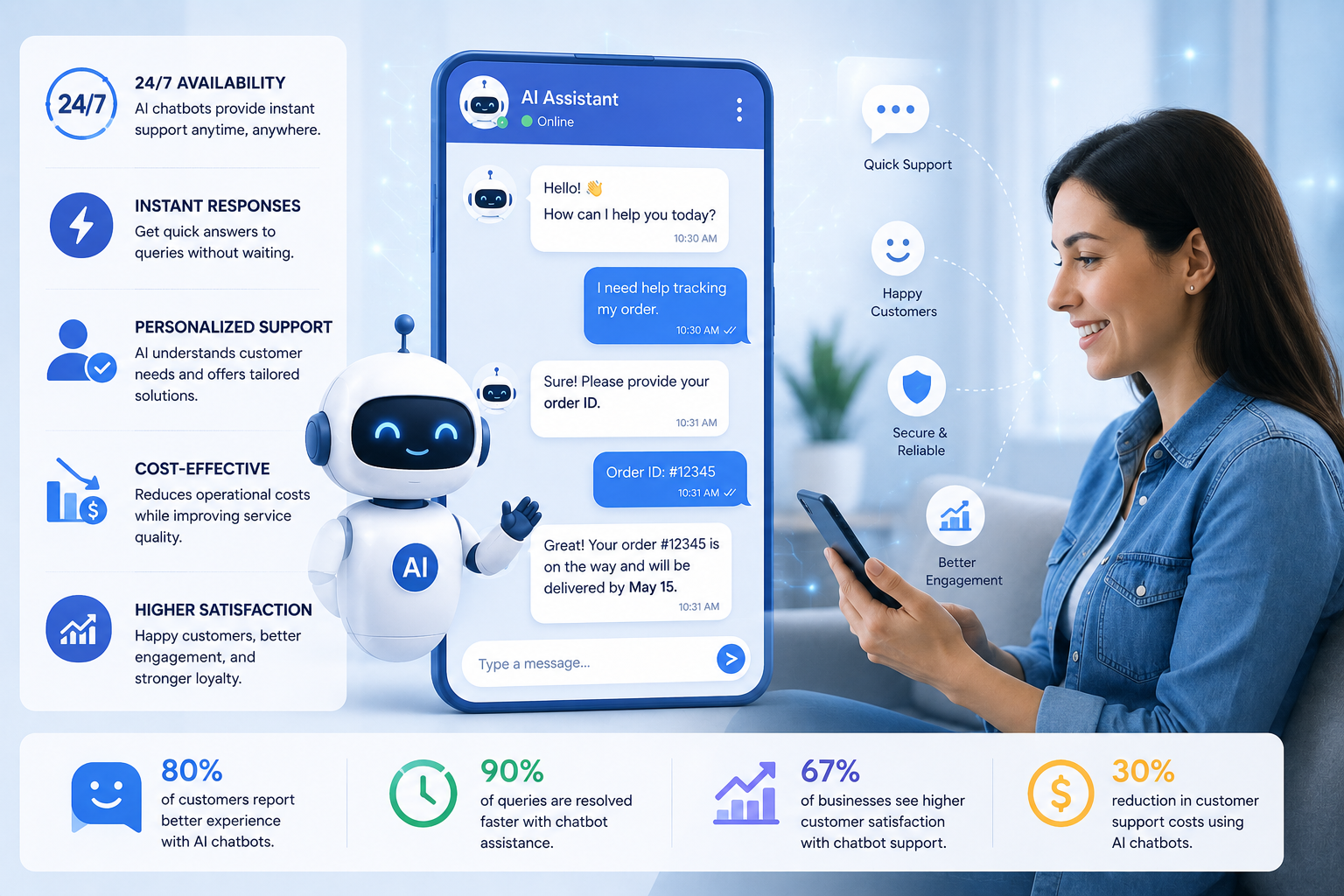
Customer support expectations have changed dramatically. Consumers expect instant responses regardless of time zones or business hours.
AI-powered support platforms such as Intercom and Zendesk AI help businesses provide immediate assistance while reducing support costs. These tools can answer common questions, process order inquiries, and guide customers through purchasing decisions.
When implemented correctly, AI chatbots enhance customer satisfaction while allowing human support agents to focus on more complex issues.
AI for Ecommerce Analytics and Business Intelligence
Data is one of the most valuable assets in ecommerce, but collecting information alone is not enough. Businesses need actionable insights to make informed decisions.
AI-powered analytics platforms help identify trends, customer behavior patterns, purchasing habits, and revenue opportunities that might otherwise go unnoticed.
Platforms integrating machine learning can provide recommendations for pricing strategies, marketing optimization, customer retention initiatives, and inventory planning.
Predictive Analytics in Ecommerce
Predictive analytics enables businesses to anticipate customer needs before they arise. By analyzing historical behavior and current trends, AI systems can predict future purchases, churn risks, and product demand.
This proactive approach helps businesses allocate resources more effectively and improve customer lifetime value.
AI-Powered Visual Search Technology
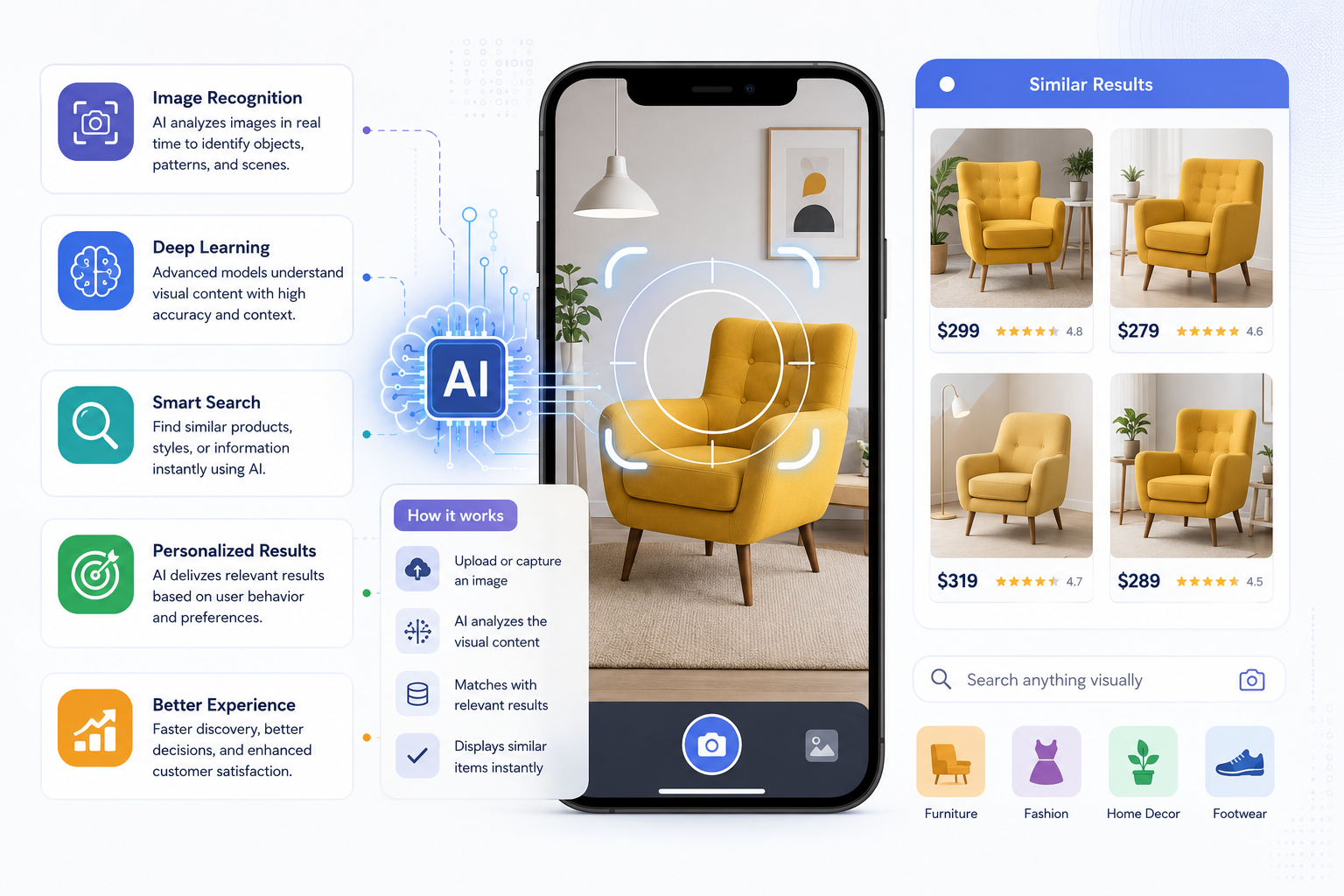
Visual search is becoming increasingly popular among ecommerce shoppers. Instead of typing product descriptions, users can upload images and find visually similar products instantly.
This technology improves product discovery while reducing friction in the buying process.
Fashion, furniture, home decor, and lifestyle brands are particularly benefiting from AI-driven visual search capabilities, helping customers find products faster and increasing purchase likelihood.

Generative AI for Product Content Management
Managing thousands of product listings manually is time-consuming and expensive. Generative AI tools help businesses create consistent product descriptions, specifications, SEO metadata, and marketing copy at scale.
As catalogs continue expanding, automation becomes essential for maintaining content quality and consistency across ecommerce platforms.
Businesses that effectively leverage generative AI can launch products faster while improving search visibility and customer engagement.
How to Choose the Right AI Tool for Your Ecommerce Business
With hundreds of AI solutions available, selecting the right technology can feel overwhelming. The best approach is to align AI investments with specific business objectives.
Evaluate Business Priorities First
If customer support is your biggest challenge, AI chatbot platforms may deliver the highest immediate impact. If marketing efficiency is a priority, content generation and email automation tools could provide stronger returns.
For businesses struggling with operational complexity, inventory forecasting and business intelligence solutions may be the better starting point.
Consider Scalability
Choose tools that can grow alongside your business. A startup’s requirements may differ significantly from those of an enterprise organization, but scalability should always be considered during technology selection.
Focus on Integration Capabilities
The most effective AI tools integrate seamlessly with existing ecommerce platforms, CRM systems, marketing software, and analytics solutions.
Strong integration reduces implementation complexity and maximizes return on investment.
The Future of AI in Ecommerce
AI innovation continues to accelerate. In the coming years, ecommerce businesses can expect even more advanced personalization, autonomous customer service, predictive supply chain management, and AI-powered shopping assistants.
According to insights from McKinsey & Company, organizations that successfully integrate AI into core business operations are increasingly outperforming competitors in efficiency and customer experience.
Meanwhile, technology leaders continue to invest heavily in generative AI, machine learning, and intelligent automation, making AI adoption a strategic necessity rather than an optional enhancement.
Businesses planning future growth should also invest in strong ecommerce foundations through professional development services such as Ecommerce Development Solutions that support AI integrations and long-term scalability.
Conclusion
AI is transforming ecommerce faster than any technology shift seen in recent years. From intelligent customer support and personalized marketing to inventory forecasting and predictive analytics, AI tools are helping businesses operate smarter, scale faster, and deliver superior customer experiences.
The best AI tools for ecommerce businesses in 2026 are not necessarily the most advanced or expensive solutions. The right tools are those that align with your business goals, integrate with your existing technology stack, and solve meaningful operational challenges.
Whether you’re a startup looking to accelerate growth, an SME seeking efficiency improvements, or an enterprise driving digital transformation, AI offers tremendous opportunities to gain a competitive advantage in the evolving ecommerce landscape.