+91 9898181101
 +1 (647) 971-4687
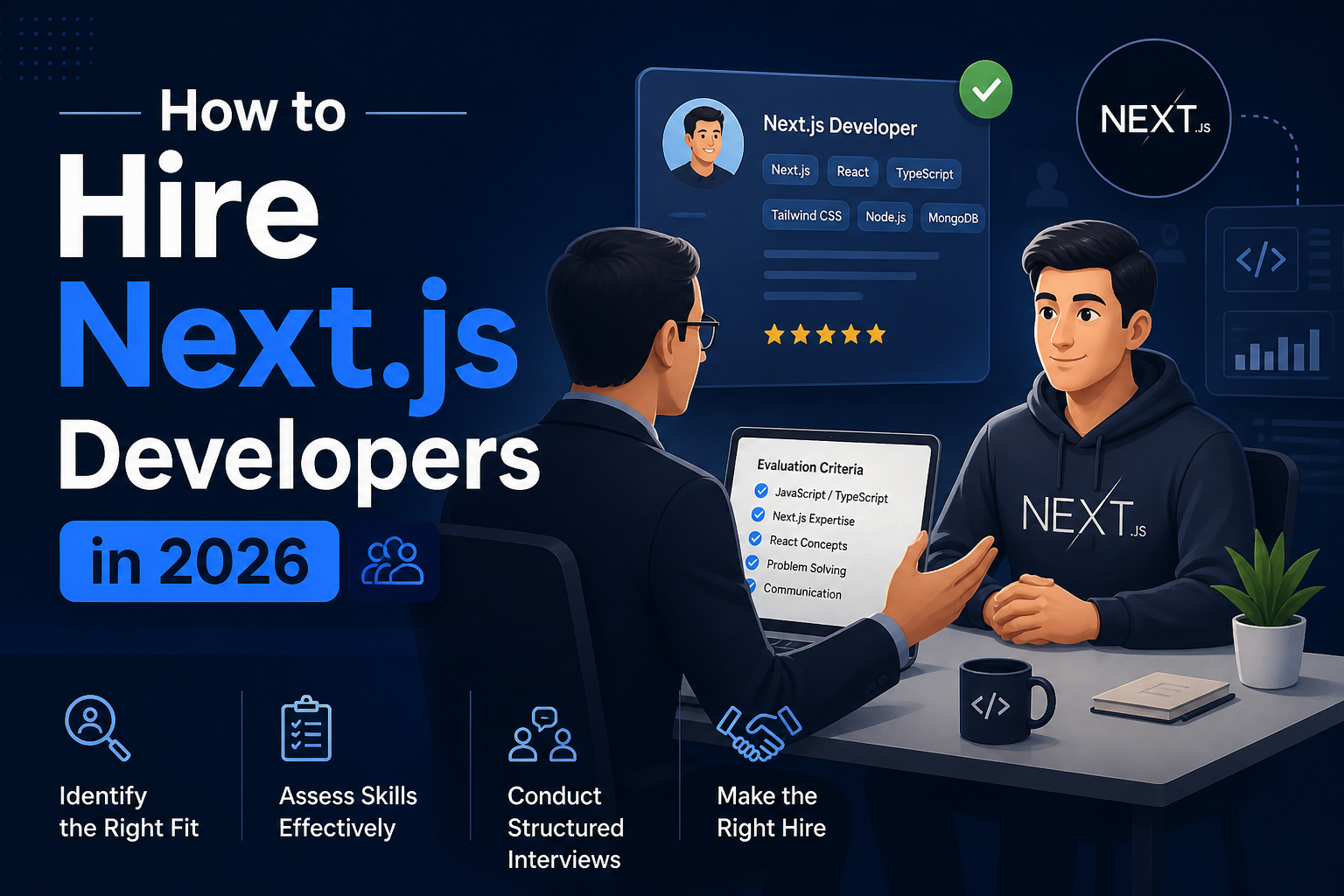
How to Hire Next.js Developers in 2026
That final sentence accomplishes a lot. Supply isn’t precisely the defining hiring difficulty at Next.js at the moment. Depending on whether your codebase is running on the App Router or the outdated Pages Router, “Next.js developer” refers to two significantly different engineers. The incorrect pool is pulled when a generic request is posted. Everyone’s time is wasted while screening without knowing which paradigm you really require. The majority of recruiting managers are unaware of this division until three months into a search that was supposed to end in six weeks.
At Ecodesoft Solutions IT staffing practice, where I oversee technical hiring, Next.js engineers have been placed across SaaS platforms, fintech products, and e-commerce builds, ranging from boutique agencies to mid-market enterprises with seven-figure monthly active user counts. When you hire through us, we get paid. That is once revealed and never brought up again.
The App Router Gap: Why Your Next Search Might Pull the Wrong Candidates
First published in 2016, Next.js is a Vercel React framework. When Vercel implemented the App Router and React Server Components as the default architecture in version 13, which was launched in late 2022, Next.js underwent a significant transition that most job listings overlook. The Pages Router is still functional. It is still used by many production applications. However, there are enough differences between the two systems that a developer who is proficient in one is not necessarily proficient in the other.
Every page in the world of Pages Router is a React component. getStaticProps or getServerSideProps are used to fetch data. In essence, the mental model is: client-side React components with a thin server layer for data. Engineers familiar with Next.js 10, 11, or 12 are well-versed in this field.
The world of App Routers is distinct. React Server Components can read straight from your database or file system without the need for an API layer because they operate on the server by default and do not have access to browser APIs, useState, or useEffect. Server Actions take the place of distinct API routes for changes, and client components must be specifically specified with 'use client'. The standard architecture includes partial hydration, streaming, and suspense limits. The patterns of component composition varies. The method of data fetching is distinct. You even have diverse perspectives on caching.
In late 2025, we searched for a Next.js senior at an Austin fintech. Using Postgres, Drizzle, and Server Actions, the client’s new product was being developed fully within the App Router. “5+ years React, Next.js experience required,” the JD stated. It makes perfect sense. Eight candidates emerged. Six were capable engineers for Pages Routers. solid individuals. Simply said, it wasn’t the proper mental model for what the client was really constructing. After one round of interviews, the client reported that “none of these candidates seem to understand Server Components.” They didn’t. That was not what the JD had requested. “App Router experience required; we are not using the Pages Router” would have made all the difference.
| Dimension | Pages Router Profile | App Router Profile |
|---|---|---|
| Data fetching | getServerSideProps, getStaticProps, SWR, React Query | Async server components, Server Actions, fetch with cache control |
| Component model | Client-first; server = data pipeline | Server-first by default; client opt-in via 'use client' |
| Routing | /pages directory, file-based | /app directory, nested layouts, route groups |
| Mutations / API calls | Separate API routes in /pages/api | Server Actions, Route Handlers in /app/api |
| Caching mental model | ISR via revalidate option on static pages | Granular per-fetch caching, revalidatePath, cache tags |
| Learning curve to switch | N/A (the starting point for most devs who learned Next.js before 2023) | 3 to 6 months to genuinely internalize for an experienced Pages Router dev |
You will interview a lot of highly qualified candidates who aren’t suitable for your position if your recruiter doesn’t know how to filter for your product roadmap’s development in the App Router.
What Next.js Developers Actually Earn in 2026
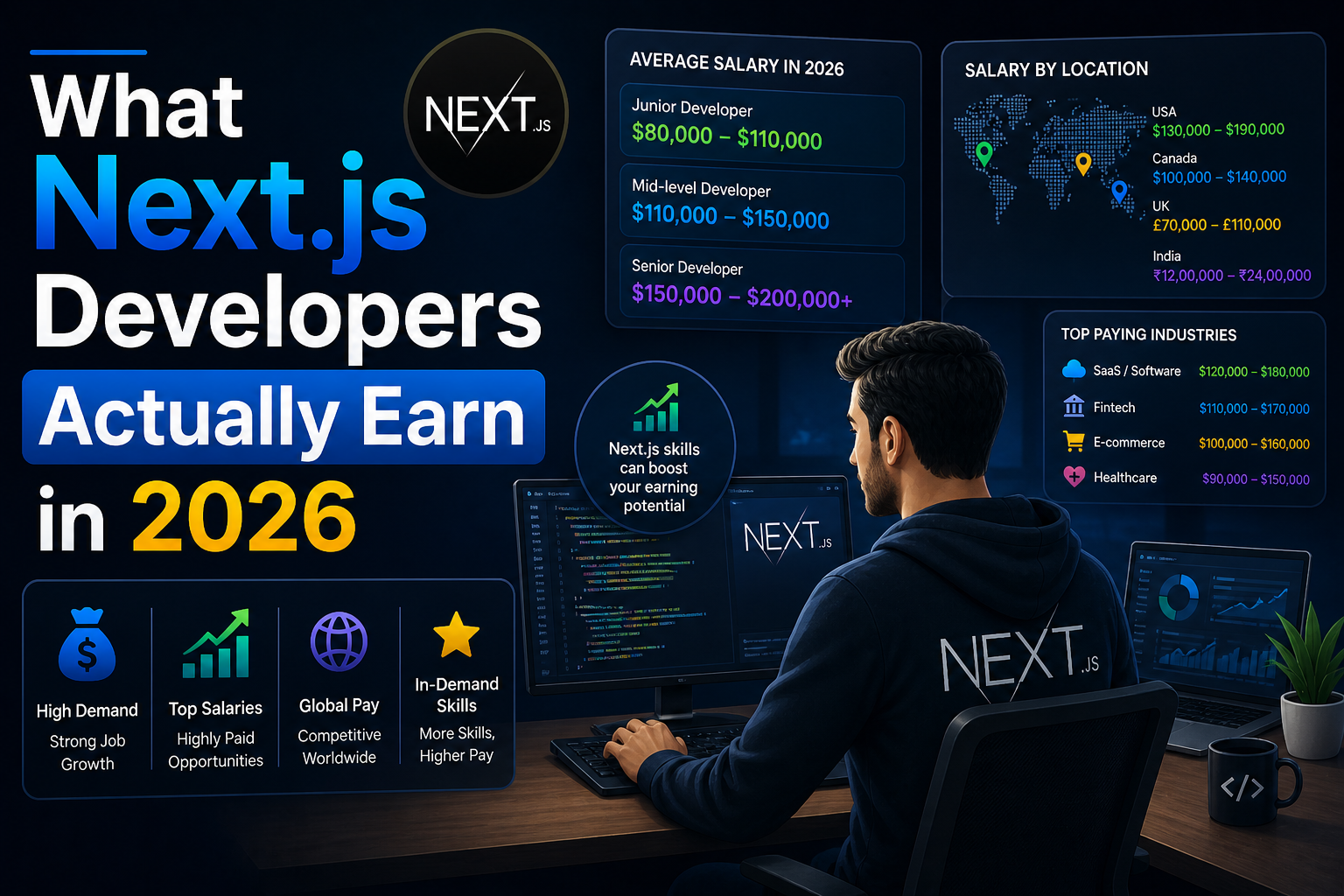
Seniority, location, and whether the position is front-end or full-stack all affect pay. The base salary ranges for direct hire in 2026 are derived from Glassdoor and Built In’s frontend engineer compensation data, which are then compared to Ecodesoft Solutions own placements. Bonuses and equity are not covered.
| Level | Experience | National Range (Base) | NYC / SF Premium |
|---|---|---|---|
| Mid-level | 2 to 5 years | $105K to $145K | $125K to $170K |
| Senior | 5 to 10 years | $145K to $190K | $175K to $225K |
| Staff / Principal | 10+ years | $185K to $240K | $220K to $290K |
| Contract (hourly) | Mid to Senior | $65 to $100/hr | $80 to $120/hr |
At the top of each band are full-stack Next.js developers who also own the backend, which includes database design, API architecture, authentication systems, and infrastructure provisioning on AWS or GCP. They frequently command salaries that are comparable to that of a separate backend engineer. When they delegate to a Node.js or Go backend, pure frontend engineers are ranked lower. When creating a budget, that distinction is important. To estimate pay for your market and seniority level, use our salary benchmark assistant.
Writing the Job Description
“Next.js and React are necessary” tells a candidate very nothing. Additionally, it is the most prevalent feature of JDs. An experienced Next.js developer would interpret that phrase as either you hired someone who developed the JD from a template or you don’t know your own stack well enough to articulate it. Neither fosters self-assurance.
What actually works:
- Clearly state the router. “Pages Router” or “App Router (Next.js 14/15)” eliminate uncertainty. When you state this clearly, engineers self-select appropriately.
- Give the ORM and database names. Supabase and Drizzle are not the same as Prisma with PostgreSQL and PlanetScale. Day one productivity is impacted by these decisions.
- Indicate if TypeScript is preferable or necessary. In actuality, every meaningful Next.js codebase in 2026 must use TypeScript. Make it clear whether you’re still using JavaScript. Typed code-loving engineers won’t join without being informed.
- Indicate the deployment environment. Vercel is not the same as self-hosting on Kubernetes or AWS ECS. The engineer must comprehend standalone output mode, custom server configurations, and reverse proxy configuration—all of which Vercel manages covertly—if you run Next.js on your own infrastructure.
I would add that if you only employ four technologies, you shouldn’t mention ten as prerequisites. The engineers that are worth employing have other options, so they don’t apply when they see a resume filled with a ton of “nice to have” keywords that obviously came from someone who Googled “what do frontend developers use.” In our experience, clearly labeled three to five hard needs and two to three preferences work far better.
Where to Find Next.js Developers in 2026
By default, LinkedIn is used. Additionally, passive prospects are less likely to reply to a cold message there, and the competition is fiercest. Some better places to start:
GitHub is not used enough. Contributions made by engineers to Next.js, the Vercel ecosystem, or well-known open source applications developed with Next.js are visible and verifiable. You can learn more from their commitment history than from a resume. Look for contributions to significant template repos with high stars, such as vercel/next.js or vercel/swr. These are engineers who express interest through public effort; they are not passive candidates.
Working engineers actually discuss issues on the official Next.js Discord channel and the Reactiflux Discord server. Technical sourcers at Ecodesoft Solutions keep an eye out for members of these communities who exhibit depth rather than just tenure. A more intriguing lead than someone with a LinkedIn profile that reads “5 years Next.js” is someone who responds to a challenging App Router question regarding streaming and Suspense bounds in a way that is obviously battle-tested.
Many of the Next.js production apps on Vercel’s own showcase give credit to their developers. The engineers who created one of those goods are a prime target if you’re creating something next to it.
Generic job board posts, a lot of outreach to people that have “Next.js” in their profile, and recruiter letters that begin with “exciting opportunity” are examples of what doesn’t perform well. This candidate pool has a small but well-connected qualified end. When outreach is sluggish, word gets out.

Interview Questions That Actually Reveal Next.js Depth
React hooks, closure behavior, and simple algorithm problems are frequently asked during standard tech interviews for frontend positions, but none of these questions reveal whether the candidate truly comprehends the server-client boundary model that distinguishes App Router applications from those created prior to Next.js 13. Five inquiries that do:
1. “Walk me through how you’d structure a Next.js App Router project with a multi-tenant setup.”
Route groups, middleware, layout nesting, and how they would manage per-tenant data isolation without leaking across RSC render borders are all covered in detail in a robust response. A poor response uses generalizations to rephrase the question.
2. “A server component is fetching slowly and blocking the render. How do you fix it?”
This inquiry relates to streaming and suspense boundaries. Slow data should be wrapped in a Suspense fallback so that the rest of the page loads while the slow data loads. When an engineer suggests, “add a loading spinner,” they lack App Router depth.
3. “Describe a time when you had to debug a hydration mismatch.”
This occurs in almost all non-trivial App Router projects. The candidate’s ability to define a hydration mismatch, explain why it occurs when server-rendered HTML does not match client-side state on first render, and describe their diagnostic procedure is more important than the answer’s substance. Here, ambiguous responses are a true warning indicator.
It’s not a technical issue, but it’s really helpful to find out which Next.js release’s breaking change caused them the most trouble and what they had to do to adjust. Current engineers have an answer. It’s common for engineers who haven’t used the framework in a year or two to not.
Take-home workouts lasting more than two to four hours are one thing that Ecodesoft Solutions advises against. Senior engineers at Next.js are quite busy. Many will just say no to a six-hour workout when they have three other options going forward. According to Ecodesoft Solution’s more than 15 years of tech placement experience, shorter exercises with a technical debriefing session work better than lengthy coding examinations for identifying engineers who are truly worth recruiting.
Offer Structure and What Closes in 2026
Senior Next.js developers are not closing on base pay alone, particularly those with App Router and full-stack depth. If the candidate has unvested equity to leave behind, a competitive offer in 2026 would contain base at market rate, equity with a clear description of the present valuation and liquidation preferences, a signing bonus, and a clear declaration of distant or hybrid expectations.
At the senior level, remote-first is still the standard. That’s what three years of dispersed work will do. Engineers who have been working from home since 2022 have no clear incentive to add a commute, and in pricey metropolitan areas, the difference in cost of living between your current location and theirs can range from $40K to $60K in base compensation required just to break even on lifestyle. The finest engineers have enough options to wait for a better fit, and we see more clients pushing for hybrid in 2026 than in 2023 or 2024. If your position necessitates three or more days in the office, set reasonable expectations and charge a premium for the location in the market you are targeting.
Extended back-and-forth on compensation following verbal acceptance is one pattern that destroys bids. Candidates will often re-engage with other processes if they have orally accepted and then receive a written offer with changed terms or slower-than-expected equity documentation. Within 48 to 72 hours of the verbal offer, send out the written offer. 92% of the positions we place are filled by Ecodesoft Solutions within the time frame we quote the client, and clients who have the offer paperwork available before to the last interview round—rather than after—consistently have the fastest closing.
Things Hiring Managers Ask
Things Hiring Managers Ask
5 to 8 weeks for mid-level and senior positions with obvious App Router or Pages Router scope; 10 to 16 weeks if the job requires specialized infrastructure knowledge, such as bespoke Next.js deployments on Kubernetes, if the JD is unclear. The average hiring time for IT positions at Ecodesoft Solutions is 17 days. When customers begin with an underspecified request and make changes in the middle of the search, Next.js searches end up closer to the longer end of that.
TypeScript vs JavaScript for your Next.js hire: does it actually matter?
In summary, any production Next.js codebase worth maintaining in 2026 will essentially need TypeScript. According to the Stack Overflow 2024 Developer Survey, over 58% of professional developers use TypeScript, and almost all significant Next.js projects in the real world use it. You can still hire if your codebase still uses JavaScript. Make it clear in the JD that you anticipate a smaller pool of candidates and longer on-ramp times.
Next.js developer vs React developer: is there a real difference worth calling out in your JD?
Not much of one three years ago. More than you could imagine in 2026. A React developer who works exclusively on the client side has never seen server-side rendering patterns, cache semantics, Edge Middleware, and deployment architecture, but Next.js developers who have integrated the App Router are familiar with these concepts. Conversely, a React developer who has solely dealt with SPAs may never have had to consider server component composition, hydration, or SSR. You want Next.js-specific experience rather than merely React proficiency for the majority of positions.
Contract or direct hire for a Next.js role?
The project lifecycle will determine this. When you require a specific build, a set schedule, and unambiguous deliverables, a contract makes sense. A Next.js contractor can set up a greenfield e-commerce development, a new frontend architecture, or an App Router migration before continuing. When the position is ongoing, you’re developing a product team, or the engineer requires context continuity over multiple releases, direct hiring makes sense. The majority of Ecodesoft Solution’s Next.js placements are either direct hire or contract-to-hire, with direct hiring more common in long-term SaaS enterprises and contract hiring more popular in agencies and product studios.
What offer actually closes a senior Next.js engineer in 2026?
Base by itself doesn’t, consistently. In 2026, the closing formula for senior engineers will be based on market rate plus considerable equity, a clear description of their liquidation preference, a signing bonus if they are leaving unvested options, and real or remote flexibility. Compared to tiered disclosure, total comp transparency at the offer stage closes more quickly. The majority of engineers at the senior level have competing offers, and they will choose the one that treats them like a peer rather than a line item.
How to Hire a Next.js Developer: The Short Version
Identify the paradigm that you are building within. Different engineers are needed for App Router and Pages Router; posting a generic JD draws the wrong crowd. Before you begin, rather than after the candidate has two competing offers in the last round, set the compensation band at market. If your codebase makes use of RSC and server component depth, check for them. and within 72 hours of the verbal, write your offer. When the final round concludes, the client is virtually never still “getting internal alignment” on comp for searches that close in five weeks.
Our software engineering staffing team conducts Next.js searches every month in the majority of major U.S. cities, including the Irvine and LA corridors, Austin, Seattle, New York, and Chicago, if you’re looking for a team that can work this quickly. Talk to a recruiter whenever the position opens, and we’ll send you a shortlist in two weeks.