+91 9898181101
 +1 (647) 971-4687

How to Build a Scalable Website & Future-Proof Your Business
Web development initiatives are frequently handled by businesses as a one-time event. After you launch the website and make a few minor adjustments, you won’t have to worry about it ever again, right? Not exactly.Technology is evolving all the time. Your website may seem awkward or function poorly sooner than you anticipate if it doesn’t stay up. Your company’s requirements may also change. For new audiences, you might need to develop bilingual sites or establish an online store. Both search engine algorithms and customer expectations are subject to change. A website that is popular and stylish now could appear incredibly outdated the next year.Making your website scalable guarantees that it can manage increasing traffic, new features, and developing technology, helping to future-proof your company by maintaining its flexibility and adaptability. This makes it simple to try out fresh tactics and re-optimize your content. In the end, this can assist your company in adapting, particularly should circumstances alter in the future.Big Picture Group Group Director Boyd Roberts is well-versed in the process of future-proofing websites. According to him, “a future-proof website is not just about the technology but about the strategy behind it.” “The secret to long-term success is careful planning, scalable infrastructure, and continuous maintenance.”A website that is future-proof will grow and change with your company, not stifle it. You’ll be prepared for whatever happens next and create flexible websites that yield rewards for many years with our advice and Boyd’s professional insights.

What is Website Scalability?
The ability of a website to manage growing volumes of traffic, data, or user interactions without sacrificing efficiency, speed, or dependability is known as website scalability.
A scalable website can expand with a company, supporting more users, features, or sophisticated operations without necessitating a full redesign.
However, making your website scalable requires both software design, such as modular code, effective database queries, and caching techniques, and technological infrastructure, such as servers, databases, and content delivery networks (CDNs).
Businesses can guarantee that their websites stay responsive, reliable, and able to accommodate long-term growth and shifting user needs by preparing for website scalability from the beginning.
The Importance of Building a Scalable Website
It’s a common misconception that creating a scalable website entails planning for the next five or 10 years. In actuality, however, consumer behavior and technology change far more quickly—sometimes in a matter of months. A website that is really scalable is designed to change at any time.
That is, of course, frequently easier said than done. Many websites don’t scale because their design prioritizes simplicity or aesthetics over adaptability.
However, the stakes are too high for any website acting as a company’s online headquarters to ignore the importance of scalability and adaptability.
Consider the following situation: Social media virality for your brand is fantastic for your company! However, the abrupt increase in traffic causes the website to breakdown, resulting in no conversions and potentially a long-lasting bad impression on prospective clients. Alternatively, think about this less dramatic but all too typical scenario in which a company never maximizes its mobile responsiveness. The majority of clients choose to make purchases on mobile devices, even though others prefer to buy on desktop computers. As a result, the company’s revenue suffers.
Failing to build scalable websites can lead to many issues, including:
- The cost of developing a new website
- Antiquated infrastructure
- Inadequate performance
- Vulnerabilities in security
Avoid these problems by creating a scalable website. That way, you can easily grow your marketing campaigns and deliver positive user experiences. The result? Better performance all around.
How to Measure Scalability
Measuring website scalability involves evaluating how well your site performs as traffic, data, or user demands increase. Key metrics include:
Assessing how effectively your website functions when traffic, data, or user needs rise is part of measuring website scalability. Important metrics consist of:
- Load testing: To observe how the website reacts under pressure, simulate an increase in the number of users. K6, LoadRunner, and Apache JMeter are examples of useful tools.
- Monitoring response time: As the number of users increases, keep an eye on how quickly pages load. Scalability limitations are shown by slower load times under increased traffic.
- Throughput measurement: Measure your server’s or application’s throughput to see how many requests per second it can process effectively.
- Error rate tracking: Keep an eye out for spikes in errors, crashes, or timeouts that indicate bottlenecks during periods of high load.
- Resource utilization metrics: To determine whether infrastructure scales well, assess CPU, memory, database, and network utilization.
When taken as a whole, these measurements show if your website can expand seamlessly or whether improvements are required to meet growing demand.
How to Build a Scalable Website
Although it’s impossible to foresee what your website will require, using scalable and flexible solutions will enable your website to expand along with your company. Here are eight doable tactics to get you going.
- Build on a Scalable CMS and Tech Stack
- Optimize for Speed and Performance
- Adopt a Mobile-Friendly and Responsive Design
- Implement Scalable Hosting and Infrastructure
- Focus on Security and Compliance
- Prioritize SEO and Content Scalability
- Automate and Integrate Marketing Technology
- Regularly Test for Continuous Optimization
1. Build on a Scalable CMS and Tech Stack
The proper tech stack is necessary for every website to be future-proof. An adjustable design makes it much easier to install an additional bedroom, much like when you expand a house. Selecting the appropriate content management system (CMS) is the first step in the process.
Boyd asserts that there isn’t a CMS that works for everyone. He states, “We adopt a platform-agnostic approach.” This means that before suggesting a solution, we give top priority to comprehending our clients’ particular demands through a discovery phase. We customize our recommendations based on company objectives, scalability demands, and technological requirements rather than promoting a one-size-fits-all CMS.
Starting an online store? A CMS with an integrated online storefront is certainly necessary. In the meanwhile, a service-oriented business can benefit greatly from a straightforward WordPress website.
Boyd goes on, “However, we often suggest a few CMS platforms based on particular use cases.” Among them are:
- Shopify is perfect for companies seeking a lightweight drop-shipping solution or those want to sell physical goods internationally with little setup.
- WordPress works well for companies that offer goods and/or services and need bespoke features that go beyond what comes pre-installed.
- For wholesalers who require a smooth invoice management system and an effective quoting system, BigCommerce is an excellent option.
- Businesses looking for an affordable, open-source e-commerce platform with lots of customization options may consider OpenCart.
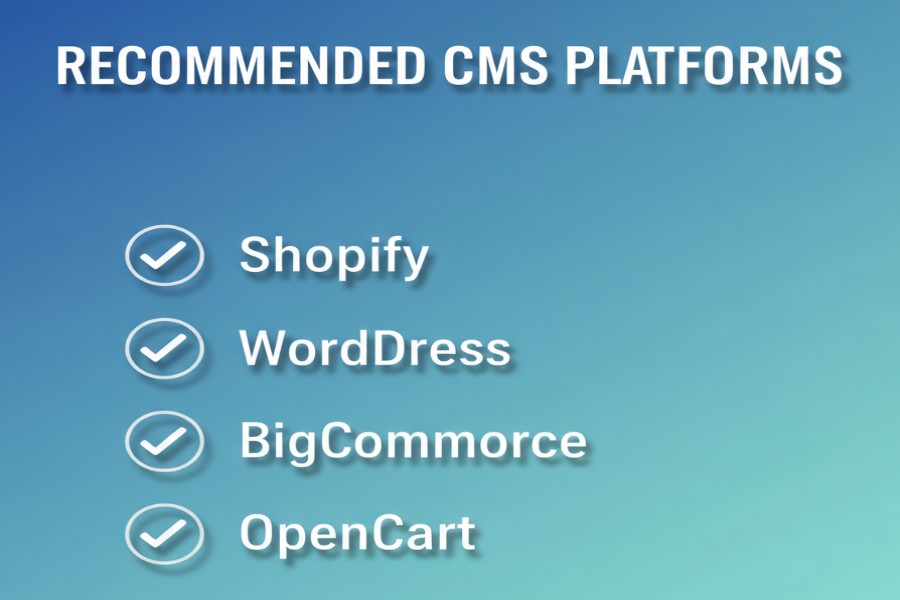
Make sure the cost of each platform is within your means by comparing their features. Even if you don’t currently require a more advanced plan, take into account the higher cost tiers.
Naturally, it’s likely that none of these platforms will meet your requirements. Boyd advises beginning from scratch in that situation. “A custom-built solution may be the best option for businesses with unique or highly complex needs,” he says. His group creates unique websites using strong frameworks, such as:
- For websites with a lot of content, Laravel’s PHP framework is perfect.
- Node.js offers a runtime environment for building scalable, high-traffic web applications.
- A JavaScript package called React.js is used to create interactive user interfaces.
- With the help of Angular.js’s JavaScript framework, you can swiftly create intricate websites.
Whichever strategy you decide on, adaptability is essential. “By concentrating on the long-term vision, scalability, and functionality required, we ensure that each client receives a future-proof solution tailored to their business growth,” says Boyd.
Think about alternative technological options as well. Application programming interfaces, or APIs, are used by many companies to link their websites to outside services. You can easily add new features without having to create them yourself by selecting scalable third-party connectors. Microservices can also be used to divide apps into smaller components for simpler scalability.
2. Optimize for Speed and Performance
Performance is crucial when it comes to future-proofing websites. Websites that are slow or glitchy can cause even the most patient users to lose interest. Poor-performing websites are also frequently penalized by search engine algorithms, which lower their rankings.
Use these easy methods to increase loading speeds:
The user doesn’t have to constantly download temporary files because browser caching saves them on the user’s device.
Spaces and other superfluous characters are eliminated from source code by code minification.
Image compression reduces the size of image files without degrading their quality.
CDNs, or content delivery networks, improve performance as well. When traffic spikes, they deploy a network of servers to distribute material. Therefore, your website will still function properly even if a news article or viral post receives a large number of visitors.
3. Adopt a Mobile-Friendly and Responsive Design
Like the majority of people, you most likely spend a lot of time using your smartphone to browse websites, including this one. Mobile devices accounted for approximately 63% of all web traffic worldwide in January 2025, up from just 51% at the end of 2016. Furthermore, there are no indications that this tendency will change.
Use a responsive, mobile-first design to future-proof your website. Make use of adaptable layouts that work with all screen sizes and gadgets. Additionally, don’t overlook touch-friendly navigation. It should be simple for users to navigate your website by tapping buttons and links.
Additionally, test and optimize for new technologies. Customers may use smartwatches or voice assistants, for example, to engage with your content.
4. Implement Scalable Hosting and Infrastructure
Businesses used to host their websites on physical servers, but a lot of them now use cloud hosting. This approach is more dependable and scalable since it makes use of networks of virtual servers. Additionally, you never have to be concerned about cloud hosting being lost in a fire or stolen.
Price should always be taken into account, but don’t always go with the least expensive alternative. Boyd says, “Businesses should prioritize more than just cost when selecting a hosting provider.” “To make sure their website stays dependable as they expand, they should concentrate on performance, security, and scalability.”
Two of the most important things Boyd takes into account are uptime and reliability. “A hosting provider should guarantee at least 99.9% uptime to ensure continuous availability,” he says.
Boyd also looks at these factors while choosing a hosting company:
- Reliability and uptime
- Performance and speed
- Backup and security
- Flexibility and scalability
- Professional assistance
Boyd suggests two providers based on these considerations. “To offer our clients the best hosting solutions, we have worked with:
Cloudways: An adaptable platform for cloud hosting that provides scalability, fast performance, and affordable options. It is an excellent option for companies of all sizes because it interfaces with service providers like AWS and Google Cloud.
WP Engine: A high-end managed WordPress hosting company renowned for its smooth scalability, performance, and security. Perfect for companies that depend significantly on uptime and performance.
Boyd goes on, “Businesses can future-proof their website, ensuring a seamless experience for their users while maintaining a competitive edge, by prioritizing functionality, reliability, and security.” To put it another way, selecting a reliable supplier is essential to long-term success.
5. Focus on Security and Compliance
Another crucial component of future-proofing websites is cybersecurity. You must take flexible precautions to keep secure since new threats are always emerging.
According to Boyd, “many small businesses start with basic hosting plans and generic website solutions to minimize initial costs as they establish their online presence.” “However, as a website expands, so do its security vulnerabilities—often without business owners fully understanding how security requirements evolve over time.”
According to Boyd, here are several common security threats:
- Cyberattacks and malware
- Attacks using distributed denial-of-service (DDoS)
- Credential theft and weak passwords
- scripting (XSS)
- Outdated plugins and software
- Attacks using social engineering and phishing
Advanced security protocols like SSL and HTTPS, which encrypt sensitive data like credit card details and login credentials, can help you protect your data. Additionally, your website needs to abide by applicable privacy rules, like the California Consumer Privacy Act and the General Data Protection Regulation.
6. Prioritize SEO and Content Scalability
Algorithms used by search engines are always changing. Organize your website for long-term search engine optimization (SEO) success to remain ahead of these developments.
Scaling a website is a crucial yet frequently disregarded aspect of SEO. According to Boyd, “scalability is essential for content-heavy websites to ensure consistent performance, seamless user experience, and efficient content management as the website grows.”
Create scalable content models with dynamic content and personalization powered by artificial intelligence (AI). Additionally, Boyd suggests utilizing a headless CMS such as Sanity or Contentful. He clarifies that these systems “store content separately and deliver it via APIs to various front-end applications.”
Do you want your mobile app and website to have the same material updated? You may save time by making all changes in one single spot using a headless CMS.
Another crucial SEO strategy is content delivery networks, or CDNs. Large media files load more quickly thanks to their ability to cache and provide material independently.
Redirects are another tool used by future-proof websites to lead users to the appropriate pages. In this manner, you can avoid updating your entire URL structure each time your content is refreshed.
7. Automate and Integrate Marketing Technology
Astute marketers are constantly looking for fresh approaches to expand their efforts. Think about using AI with email marketing and customer relationship management systems. You may automate tasks for simple scalability with this combo. For example, you might use automation systems to send hundreds of new clients welcome emails in a matter of minutes.
AI is a potent tool for future-proofing websites as well. “Artificial Intelligence (AI) and machine learning algorithms can automate performance tuning, optimizing website speed, caching, and load balancing based on real-time user traffic patterns,” says Boyd. This guarantees smooth scalability without the need for human intervention.
AI is used, for example, by programs like Free LoadMaster and HAProxy to forecast traffic patterns and make necessary adjustments. Uncertain about which options to choose? Always seek for scalable solutions that may expand along with your company.
8. Regularly Test for Continuous Optimization
Don’t give up on your website after the big launch; you’ve put a lot of effort into it. Boyd cautions, “No website is ever done.” “Websites that are not regularly maintained run the risk of becoming outdated, vulnerable, or inefficient because technology is constantly evolving.”
Monitor health, analytics, and heatmaps on a regular basis to keep your website current. This phase will assist you in identifying and resolving problems early on. To improve your content, you should also make use of A/B testing frameworks.
To learn about new trends and technology outside of your website, follow thought leaders and industry news.
How Outsourcing Website Development Can Future Proof Your Growth
Let’s be honest: If you’re not tech-savvy, future proofing a website might take a lot of effort. For this reason, a lot of companies contract out these jobs to web developers and designers that have experience in future-proofing. Outsourcing is less expensive than recruiting a permanent in-house team, and these experts may assist you in implementing new technology more quickly.
Prepare for any Scenario With a Scalable Website
Although they may appear unrelated at first, web design and marketing are closely related. Your website will be easier to adjust to new tactics and trends if it is more scalable. Additionally, when your promotion pays off, a website that is future-proof can manage the skyrocketing traffic.
Building scalable website infrastructure is obviously not an accident. It necessitates meticulous preparation, specific expertise, and—above all—a bold vision.